Home › Forums › Laser Marking Forum › The Comprehensive Guide to Laser Marking
- This topic is empty.
Viewing 1 post (of 1 total)
-
AuthorPosts
-
02/24/2026 at 3:09 AM #700
Dwmin
KeymasterIntroduction
In the fast-paced world of modern manufacturing, precision and efficiency are of utmost importance. Laser marking has emerged as a game-changing technology that offers unparalleled accuracy and versatility in marking various materials. This comprehensive guide will delve into the intricacies of laser marking, exploring its different types, advantages, disadvantages, and applications. Whether you are a manufacturer looking to enhance your production process or an enthusiast interested in the latest technological advancements, this guide will provide you with valuable insights into the world of laser marking.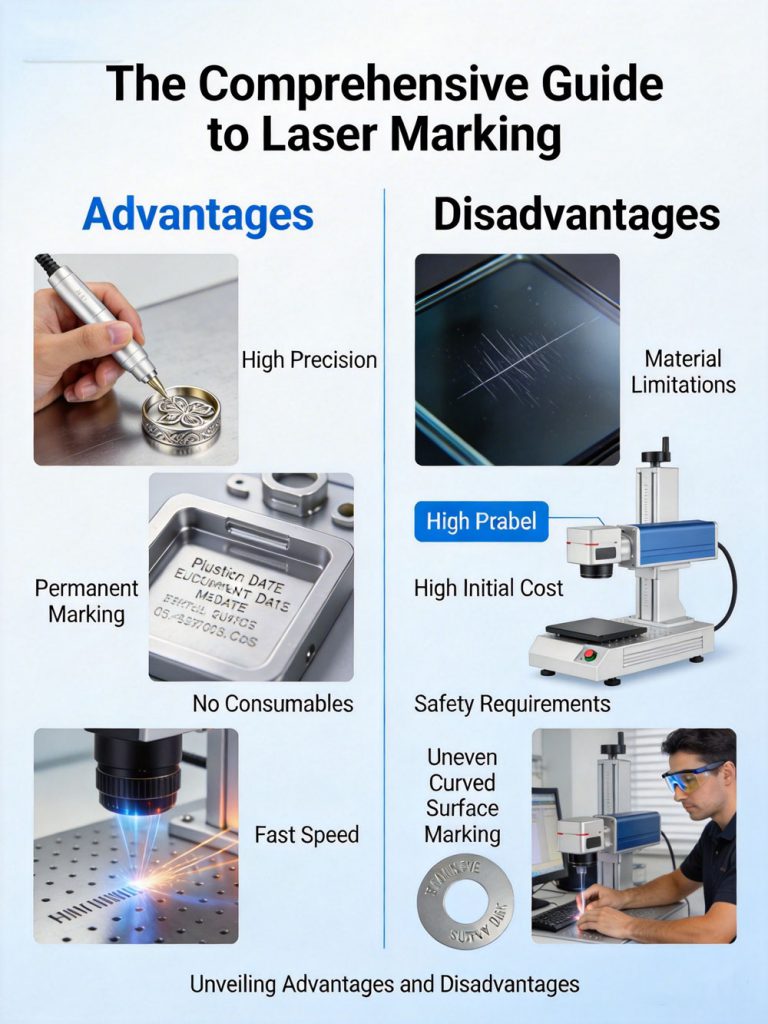
What is Laser Marking?
Laser marking is a non-contact process that uses a focused beam of light to create permanent marks on the surface of a material. The laser beam interacts with the material, causing a change in its surface properties, such as color, texture, or chemical composition. This results in a clear, high-contrast mark that is resistant to wear, fading, and tampering. Laser marking can be used to mark a wide range of materials, including metals, plastics, glass, ceramics, and wood. It is commonly used in industries such as automotive, aerospace, electronics, medical, and packaging to add logos, serial numbers, barcodes, and other identification marks to products.Types of Laser Marking Machines
There are several types of laser marking machines available on the market, each with its own unique features and capabilities. The most common types include fiber laser marking machines, CO₂ laser marking machines, UV laser marking machines, and green laser marking machines.1. Fiber Laser Marking Machines
Fiber laser marking machines use a fiber laser source to generate a high-power laser beam. The laser beam is focused onto the surface of the material using a series of lenses and mirrors, creating a permanent mark. Fiber laser marking machines are known for their high precision, speed, and durability. They are ideal for marking metals and some non-metallic materials, such as stainless steel, aluminum, copper, and engineering plastics.Advantages
- High Durability: The marks made with fiber laser marking are permanent and resistant to wear, fading, and tampering. They can withstand harsh environmental conditions, such as heat, chemicals, and UV radiation.
- Minimal Maintenance: Fiber laser marking machines have a long lifespan and require very little maintenance. They do not have any moving parts that can wear out or break, and they do not require any consumables, such as ink or toner.
- High Precision: Fiber laser marking machines can produce extremely precise and detailed marks, with a resolution of up to 0.001mm. This makes them ideal for marking small text, complex patterns, and micro-components.
- Fast Processing Speed: Fiber laser marking machines can mark products at a high speed, with a marking rate of up to 10,000 characters per second. This makes them suitable for high-volume production environments.
Disadvantages
- Limited Material Range: Fiber laser marking machines are not suitable for marking all types of materials. They work best on metals and some non-metallic materials, but they may not be able to mark materials such as wood, fabric, or paper.
- Color Limitations: Fiber laser marking machines can only mark materials in shades of black and gray. They cannot produce color marks, which may be a disadvantage for some applications.
- Surface Sensitivity: Some shiny surfaces, such as copper or silver, may be more difficult for fiber laser marking machines to mark. Higher power or specialized laser sources may be required for these materials.
Applications
- Automotive Industry: Fiber laser marking machines are used to mark part numbers, serial numbers, and logos on automotive components, such as engine parts, transmission parts, and body panels.
- Aerospace Industry: Fiber laser marking machines are used to mark identification marks on aerospace components, such as turbine blades, landing gear, and fuselage parts.
- Electronics Industry: Fiber laser marking machines are used to mark serial numbers, barcodes, and logos on electronic components, such as printed circuit boards, connectors, and semiconductors.
- Medical Industry: Fiber laser marking machines are used to mark identification marks on medical devices, such as surgical instruments, implants, and drug delivery systems.
- Packaging Industry: Fiber laser marking machines are used to mark batch numbers, expiration dates, and barcodes on packaging materials, such as plastic bottles, glass jars, and metal cans.
2. CO₂ Laser Marking Machines
CO₂ laser marking machines use a CO₂ laser source to generate a laser beam in the infrared range. The laser beam is focused onto the surface of the material using a series of lenses and mirrors, creating a permanent mark. CO₂ laser marking machines are known for their versatility and ability to mark a wide range of materials, including wood, glass, plastic, leather, and paper.Advantages
- Versatile Material Compatibility: CO₂ laser marking machines can mark a wide range of materials, including organic materials such as wood, glass, plastic, leather, and paper. They can also mark some metals, such as anodized aluminum and coated metals.
- High-Quality Marks: CO₂ laser marking machines can produce clear, high-contrast marks with a smooth surface finish. The marks are resistant to wear, fading, and tampering.
- Large Marking Area: CO₂ laser marking machines can mark large areas of material, making them suitable for marking large products or multiple products at once.
- Cost-Effective: CO₂ laser marking machines are relatively affordable compared to other types of laser marking machines. They also have low operating costs, as they do not require any consumables.
Disadvantages
- Not for Metals: CO₂ laser marking machines are not suitable for marking untreated metals, as the laser beam reflects off the surface of the metal. They can only mark metals that have been coated or anodized.
- Higher Maintenance Needs: CO₂ laser marking machines have a gas-filled tube that needs to be replaced periodically. This can increase the maintenance costs and downtime of the machine.
- Larger Footprint: CO₂ laser marking machines are generally larger than fiber laser marking machines, which may require more space in the production facility.
- Consumable Parts: CO₂ laser marking machines may require consumable parts, such as lenses and mirrors, which need to be replaced periodically.
Applications
- Woodworking Industry: CO₂ laser marking machines are used to mark logos, patterns, and text on wooden products, such as furniture, signs, and crafts.
- Textile and Apparel Industry: CO₂ laser marking machines are used to cut and mark fabrics, such as denim, leather, and synthetics. They can create unique designs with high accuracy for clothing and other textile products.
- Packaging Industry: CO₂ laser marking machines are used to mark date codes, batch numbers, and barcodes on packaging materials, such as plastic bottles, glass jars, and metal cans.
- Promotional Products Industry: CO₂ laser marking machines are used to add logos, messages, and custom designs to promotional products, such as pens, keychains, and USB drives.
3. UV Laser Marking Machines
UV laser marking machines use a UV laser source to generate a laser beam in the ultraviolet range. The laser beam is focused onto the surface of the material using a series of lenses and mirrors, creating a permanent mark. UV laser marking machines are known for their high precision and ability to mark heat-sensitive materials without causing damage.Advantages
- Cold Marking Process: UV laser marking machines use a cold marking process, which means that the laser beam does not generate heat. This prevents damage to heat-sensitive materials, such as plastics, glass, and ceramics.
- Exceptional Precision: UV laser marking machines can produce extremely small and detailed marks with a resolution of up to 0.0001mm. This makes them ideal for marking micro-components and delicate materials.
- Wide Material Range: UV laser marking machines can mark a wide range of materials, including plastics, glass, ceramics, and some metals. They can also mark materials that are difficult to mark with other types of laser marking machines, such as PVC and ABS.
- Permanent Marks: The marks made with UV laser marking are permanent and resistant to wear, fading, and tampering. They can withstand harsh environmental conditions, such as heat, chemicals, and UV radiation.
Disadvantages
- Higher Cost: UV laser marking machines are more expensive than other types of laser marking machines. The laser source of a UV laser marking machine is one of the most expensive components, which contributes to the higher initial cost.
- Slower Marking Speed: The cold marking process of UV laser marking machines is usually slower than the thermal methods of fiber or CO₂ laser marking machines. This may be a disadvantage for high-volume production environments.
- Lower Power Output: UV laser marking machines have a lower power output compared to other types of laser marking machines. This can limit the depth and speed of the marking process.
Applications
- Medical and Pharmaceutical Industry: UV laser marking machines are used to mark medical plastics and glass vials. The cold marking process ensures that the sterile environment is not compromised.
- Semiconductor Industry: UV laser marking machines are used to mark silicon wafers and microelectronic components. The high precision and low heat prevent damage to delicate parts.
- Plastics Manufacturing Industry: UV laser marking machines are used to create high-contrast marks on a variety of plastic types, such as PVC and ABS. The marks are clear and durable, without melting or foaming the plastic.
- Glass and Ceramics Industry: UV laser marking machines are used to mark glass and ceramics. The process creates tiny fractures on the surface of the material, resulting in a clear, high-contrast mark.
4. Green Laser Marking Machines
Green laser marking machines use a green laser source to generate a laser beam in the visible green range. The laser beam is focused onto the surface of the material using a series of lenses and mirrors, creating a permanent mark. Green laser marking machines are known for their high visibility and ability to mark materials that are difficult to mark with other types of laser marking machines.Advantages
- High Visibility: The green laser beam is highly visible, making it easy to align the laser marking machine with the material. This ensures that the mark is placed accurately and precisely.
- Wide Material Range: Green laser marking machines can mark a wide range of materials, including metals, plastics, glass, ceramics, and wood. They can also mark materials that are difficult to mark with other types of laser marking machines, such as copper and silver.
- High Precision: Green laser marking machines can produce extremely precise and detailed marks, with a resolution of up to 0.001mm. This makes them ideal for marking small text, complex patterns, and micro-components.
- Fast Processing Speed: Green laser marking machines can mark products at a high speed, with a marking rate of up to 10,000 characters per second. This makes them suitable for high-volume production environments.
Disadvantages
- Higher Cost: Green laser marking machines are more expensive than other types of laser marking machines. The laser source of a green laser marking machine is one of the most expensive components, which contributes to the higher initial cost.
- Limited Power Output: Green laser marking machines have a lower power output compared to other types of laser marking machines. This can limit the depth and speed of the marking process.
- Surface Sensitivity: Some shiny surfaces, such as copper or silver, may be more difficult for green laser marking machines to mark. Higher power or specialized laser sources may be required for these materials.
Applications
- Jewelry Industry: Green laser marking machines are used to mark logos, patterns, and text on jewelry, such as rings, bracelets, and necklaces. The high precision and visibility of the green laser beam ensure that the mark is placed accurately and precisely.
- Electronics Industry: Green laser marking machines are used to mark serial numbers, barcodes, and logos on electronic components, such as printed circuit boards, connectors, and semiconductors. The high precision and speed of the green laser beam make it suitable for high-volume production environments.
- Medical Industry: Green laser marking machines are used to mark identification marks on medical devices, such as surgical instruments, implants, and drug delivery systems. The high visibility of the green laser beam ensures that the mark is easily readable.
- Packaging Industry: Green laser marking machines are used to mark batch numbers, expiration dates, and barcodes on packaging materials, such as plastic bottles, glass jars, and metal cans. The high visibility of the green laser beam ensures that the mark is easily visible.
Fiber VS CO₂ VS UV Laser Marking Machines
When choosing a laser marking machine, it is important to consider the specific requirements of your application. The following table compares the key features of fiber, CO₂, and UV laser marking machines:Feature Fiber Laser CO₂ Laser UV Laser Material Compatibility Best for metals and some non-metallic materials Best for organic materials, such as wood, glass, and paper Wide range of materials, including plastics, glass, ceramics, and some metals Precision High precision, suitable for small details Good precision, suitable for general marking Exceptional precision, ideal for micro-marking Speed Very fast Fast Slower Cost Medium to high initial cost, low operating cost Low to medium initial cost, moderate operating cost High initial cost, higher operating cost Power Requirements Efficient, low electricity usage Higher electricity usage Moderate electricity usage Conclusion
Laser marking is a versatile and efficient technology that offers many advantages over traditional marking methods. It can be used to mark a wide range of materials, produce high-quality marks, and improve the traceability and authenticity of products. When choosing a laser marking machine, it is important to consider the specific requirements of your application, such as the type of material, the size and complexity of the mark, and the production volume. Fiber laser marking machines are ideal for marking metals and some non-metallic materials, CO₂ laser marking machines are suitable for marking organic materials, and UV laser marking machines are best for marking heat-sensitive materials. By choosing the right laser marking machine for your application, you can improve the quality, efficiency, and profitability of your production process. -
AuthorPosts
Viewing 1 post (of 1 total)
- You must be logged in to reply to this topic.