
Laser marking technology has become a cornerstone of industrial identification, traceability, and product personalization. As global manufacturing shifts toward higher automation, traceability requirements, and quality standards, lasers are now preferred over traditional marking methods such as stamping, inkjet, or etching due to their speed, precision, permanence, and lower long-term operating costs.
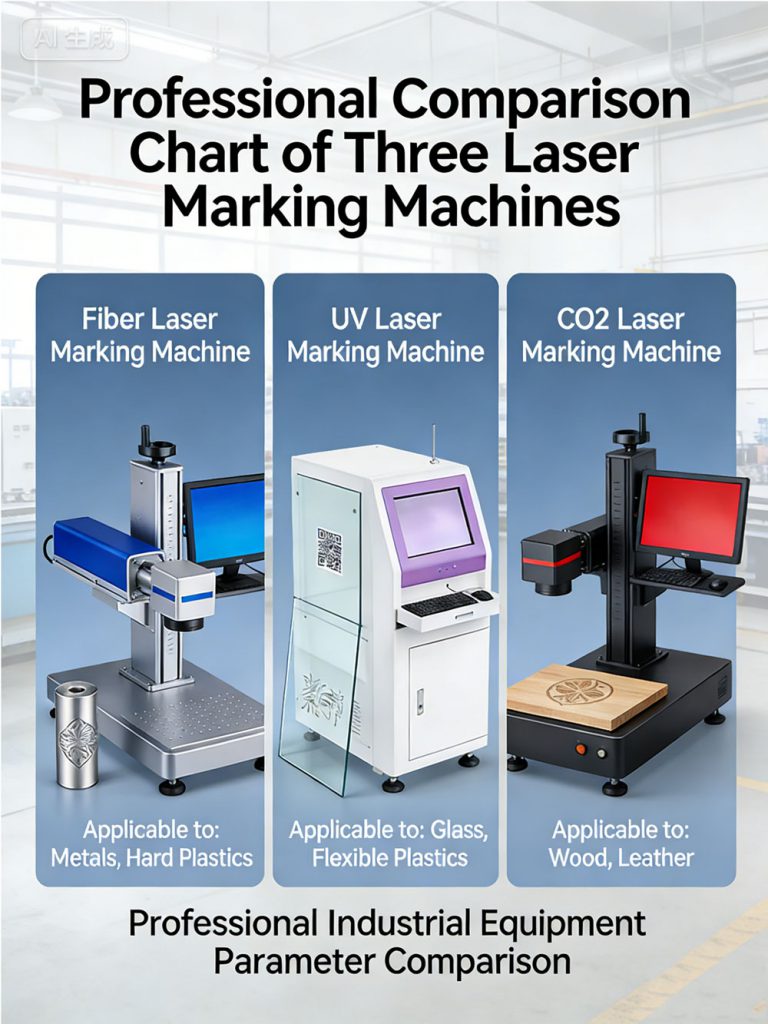
However, not all laser systems are the same: fiber, ultraviolet (UV), and carbon dioxide (CO₂) lasers differ substantially in how they operate, which materials they can process, and how they perform in real-world production environments. Understanding these differences is critical for specifying the right type of laser for applications ranging from automotive component serialization to packaging printing and microelectronics.
Contents
Fundamental Differences in Laser Types
1. Wavelength and Energetic Mechanisms
Each laser type produces light at a distinct wavelength, which determines how energy couples with matter:
- Fiber Lasers: Emit in the near-infrared (~1064 nm), generating high energy density that heats and modifies material surfaces.
- UV Lasers: Emit short wavelengths (~355 nm) much closer to the visible spectrum; they interact with materials through photochemical effects rather than heat.
- CO₂ Lasers: Emit long infrared wavelengths (~10.6 µm) absorbed well by organic and non-metallic materials, producing thermal ablation marks.
These physical differences lead to distinct marking processes: fiber and CO₂ lasers typically mark via heating and vaporization of surface material, while UV lasers often break molecular bonds with minimal thermal transfer—a process often called “cold marking.”
Material Compatibility and Application Domains
Fiber Lasers
Fiber lasers excel on metals and some engineering plastics. Their infrared energy couples efficiently with metals such as stainless steel, aluminum, copper, and brass, creating deep, permanent marks suitable for part identification and traceability. This makes them ideal for industrial sectors that require robust marking on hard surfaces, including automotive components, aerospace parts, and tooling.
Pros:
- High precision and repeatability
- Excellent for barcodes, serial numbers, and high-contrast marks
- Efficient and reliable for high-volume production
Limitations:
- Limited effectiveness on transparent or non-absorbing materials like glass or some plastics
- Higher initial investment than some alternatives
UV Lasers
UV lasers provide minimal heat impact and extremely fine detail, which makes them uniquely suited to heat-sensitive, delicate, or very small features. These traits are valuable in microelectronics marking, medical device coding, and thin film identification, where thermal distortion must be avoided.
Pros:
- Cold marking reduces risk of burning or warping
- Exceptional accuracy for micro text, fine graphics, and semiconductor features
Limitations:
- Lower marking speed compared to fiber lasers
- Higher equipment cost and specialized maintenance
CO₂ Lasers
CO₂ lasers are particularly effective with organic and non-metallic substrates such as wood, paper, leather, acrylics, textiles, and packaging materials. Their long wavelength interacts strongly with carbon-based and polymer surfaces, generating clear marks by thermal ablation.
Pros:
- Versatile across many non-metal material types
- Relatively lower initial purchasing cost
Limitations:
- Not suitable for marking metals without coatings or surface modification
- Larger heat-affected zones can risk material damage on sensitive parts
Precision, Speed and Cost Trade-offs
Selecting the appropriate laser choice involves balancing precision, throughput, and budget:
- Precision: UV lasers typically deliver the highest resolution and smallest heat-affected zones, followed by fiber lasers; CO₂ lasers provide moderate precision suitable for larger text or less detailed graphics.
- Production Speed: Fiber lasers reliably deliver the fastest marking rates for metals and many plastics, making them ideal for high-volume production lines.
- Cost Considerations: CO₂ systems often have lower upfront costs but higher long-term maintenance due to gas tubes and optics. Fiber lasers require higher initial capital but offer lower operating costs and maintenance. UV lasers sit at the higher end of initial cost due to their specialized optical systems and power requirements.
Industry Trends and Operational Realities
From an industry perspective, fiber lasers dominate modern manufacturing due to their versatility, energy efficiency, and integration ease into automated systems. Their high energy efficiency and long life cycles reduce operating costs over time, supporting lean, sustainable manufacturing models.
However, no single laser type fits all use cases:
- UV lasers are indispensable where heat must be minimized.
- CO₂ lasers remain the best choice for large, organic, or porous material marking where cost sensitivity and material compatibility are priorities.
Making an informed choice requires not just comparing wavelengths and material compatibility, but also evaluating production throughput, expected maintenance overhead, future flexibility, and total cost of ownership.
Conclusion: Informed Specification Beats One-Size-Fits-All
Laser marking technology continues to evolve rapidly, driven by demand for higher traceability, precision, and automation across industries. Understanding the technical trade-offs between fiber, UV, and CO₂ lasers—especially how wavelength influences material interaction—empowers engineers and production managers to align marking technologies with real-world requirements rather than generic specifications.
In practice, a hybrid approach is emerging in advanced production environments: integrating multiple laser types within a factory to handle diverse materials and marking needs. This strategy maximizes material coverage, improves quality, and future-proofs marking investments against evolving product portfolios.