
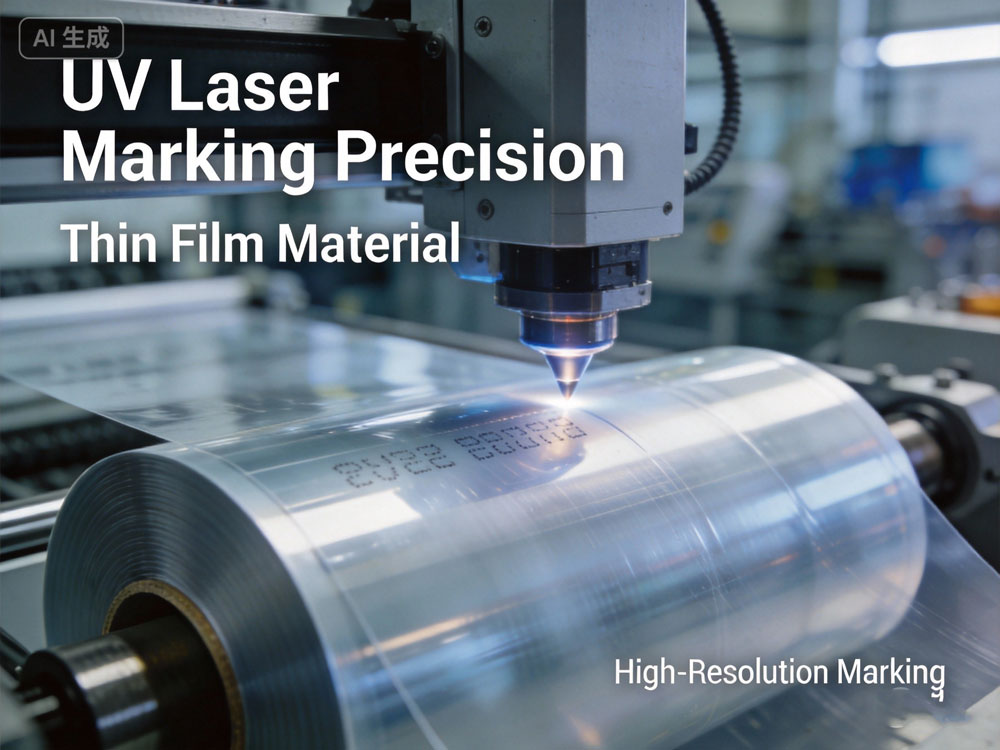
As manufacturing increasingly incorporates ultra-thin, flexible substrates—such as in electronics, packaging, medical devices, and advanced composites—effective marking solutions must deliver high precision without damaging sensitive materials. Traditional thermal marking methods often generate enough heat to warp, delaminate, or compromise these substrates, prompting a shift toward ultraviolet (UV) laser technology, which has unique advantages rooted in physics and material interaction.
Contents
- 1 1. Photochemical, Cold Marking Protects Delicate Materials
- 2 2. Extremely Fine Resolution Enables Micro-Scale Features
- 3 3. High Contrast Across Diverse Thin Film Materials
- 4 4. Contactless Marking Without Consumables or Contamination
- 5 5. Seamless Integration Into High-Throughput Production Lines
- 6 Industry Context: Why UV Lasers Are Gaining Traction
- 7 Conclusion: Laser Choice Matters in Thin Film Applications
1. Photochemical, Cold Marking Protects Delicate Materials
UV lasers operate at a short wavelength (~355 nm) that interacts with materials predominantly through photochemical ablation instead of heating them thermally. This process breaks molecular bonds at the very surface without significant heat transfer to the surrounding area, thereby creating marks while minimizing thermal stress and distortion.
In practical terms:
- Heat-sensitive films such as polyimide (PI), polyethylene terephthalate (PET), and flexible printed circuits benefit because the marking does not induce warping, bubbling, or layer separation.
- Transparent or reflective barrier films, multilayer laminates, and coated foils retain structural integrity throughout marking.
This “cold” characteristic is especially valuable in industries such as microelectronics packaging, display manufacturing, and biomedical device fabrication, where even minor distortions can render a part unusable.
2. Extremely Fine Resolution Enables Micro-Scale Features
The shorter UV wavelength allows the laser beam to focus into an extremely small spot size, far smaller than longer wavelength lasers such as infrared or CO₂ units.
This enables:
- Ultra-fine text and graphics that maintain readability at micro-scales.
- High-density data codes (e.g., micro QR codes) on curved or moving thin films.
- Repeatable placement accuracy down to a few microns, which is essential in fields where space is at a premium, such as semiconductor labeling and medical sensor marking.
This precision extends beyond surface marking: in many cases, it supports micro-level surface modification without disturbing underlying layers, which is crucial for low-tolerance products.
3. High Contrast Across Diverse Thin Film Materials
One of the universal advantages of UV lasers is their ability to produce clear, high-contrast marks on a wide variety of thin film substrates. The short wavelength is absorbed efficiently by many polymers and coated materials, even when they are transparent or reflective—challenging conditions for other laser technologies.
This capability ensures:
- Consistent code readability for traceability in supply chains.
- Reliable branding and visual quality in consumer and medical packaging.
- Better quality control through enhanced machine vision and inspection compatibility.
High contrast also improves the machine readability of barcodes and serialization codes, reducing scanning errors in automated production environments and logistics tracking.
4. Contactless Marking Without Consumables or Contamination
UV laser marking is entirely non-contact and does not require ink, solvents, labels, or other consumables. This yields several operational benefits:
- Zero risk of erroneous contamination on precision parts.
- Elimination of ongoing consumable costs and associated supply chain complexity.
- Suitable for cleanroom and sterile environments, such as pharmaceutical packaging or medical device manufacturing.
The absence of consumables also dramatically reduces downtime due to ribbon, ink, or coating replacement, boosting overall production efficiency.
5. Seamless Integration Into High-Throughput Production Lines
Modern UV laser marking systems are designed to integrate directly into inline manufacturing processes. Roll-to-roll marking on continuous film webs and integration with vision systems, factory MES, ERP, and quality control platforms accelerate digitization and traceability.
This enables real-time serialization, dynamic data marking, and robust tracking across production batches—capabilities that are increasingly mandated in regulatory environments and industry standards.
Industry Context: Why UV Lasers Are Gaining Traction
Industry adoption of UV lasers for thin film marking is influenced by several macro trends:
- Miniaturization across electronics and medical devices demands marking methods that can cope with micro-scales without inducing damage or distortion.
- Regulatory rigor in traceability and safety, especially in pharmaceuticals and food packaging, means markings must be precise, permanent, and readable throughout a product’s lifecycle.
- Lean and smart manufacturing models favor technologies that reduce waste, lower operational costs, and integrate smoothly into automated workflows.
Historically, thermal methods like inkjet or mechanical stamping struggled with reliability and precision on ultra-thin, flexible films, thereby opening a niche that UV laser systems now dominate due to their unique physical interaction with materials.
Conclusion: Laser Choice Matters in Thin Film Applications
In sectors where material integrity and mark fidelity are critical, UV laser technology stands out because of its cold, high-resolution, contactless marking capabilities. Engineering decisions that favor UV marking over thermal alternatives can significantly improve yields, reduce defect rates, and enable advanced traceability that supports modern manufacturing and compliance goals. UV lasers are not simply one option among many; they are often the technologically appropriate choice for thin film marking in high-precision, high-value production contexts.