
In food packaging, product identification and traceability are no longer optional — they are regulatory necessities and brand-integrity cornerstones. Two dominant technologies have emerged for marking food packages: laser coding and inkjet printing. Each has evolved rapidly over the past decade, driven by tighter safety standards, digital transformation in manufacturing, and consumer demands for transparency. This article compares these technologies, explores industry background, and offers reasoned insights into which is “better” under various scenarios.
Contents
Industry Background: Why Coding Matters in Food Packaging
Food manufacturers must meet an expanding set of global and regional requirements. The EU’s FIC (Food Information to Consumers), the U.S. FDA’s labeling standards, and traceability laws like DSCSA (Drug Supply Chain Security Act) all mandate accurate production dates, batch codes, and expiry dates. Additionally, brand owners are leveraging unique identifiers for anti-counterfeiting and supply chain analytics.
This regulatory pressure, combined with high consumer expectations for safety and transparency, has compelled brands to adopt marking technologies that are:
- Reliable — minimal downtime or errors
- High-resolution — capable of producing readable codes on diverse substrates
- Cost-effective — low total cost of ownership (TCO) over lifecycle
- Sustainable — minimal waste, energy efficient
Laser coding and inkjet printing dominate this space because they meet many of these needs in different ways.
Technology Overview
Laser Coding
Laser coders use concentrated beams to etch or ablate information on packaging surfaces. Common laser types include CO₂, fibre, and UV lasers.
Strengths:
- High precision and resolution: Ideal for QR codes, barcodes, and fine text.
- Low consumables cost: No inks or solvents.
- Permanent marks: Resistant to abrasion and environmental conditions.
- Fast and repeatable: High throughput with minimal maintenance.
Weaknesses:
- High capital cost: Initial investment is significant compared to basic inkjet systems.
- Material sensitivity: Not all substrates respond well to laser marking (e.g., some plastics may discolor).
- Safety infrastructure: Requires enclosures or safety shields because of powerful beams.
Inkjet Printing
Inkjet systems propel tiny droplets of ink onto the surface. Two common variants are continuous inkjet (CIJ) and thermal inkjet (TIJ).
Strengths:
- Lower upfront cost: More accessible for small and medium producers.
- Versatility: Compatible with various substrates when matched with right inks.
- Color printing: Capable of multi-color codes or branding elements.
- Flexible print positions: Can print on irregular shapes or curved surfaces.
Weaknesses:
- Consumables cost: Inks and solvents are ongoing expenses.
- Maintenance needs: Printheads can clog; require cleaning.
- Environmental impact: Solvents can produce VOC emissions and waste.
Comparative Evaluation
Accuracy and Durability
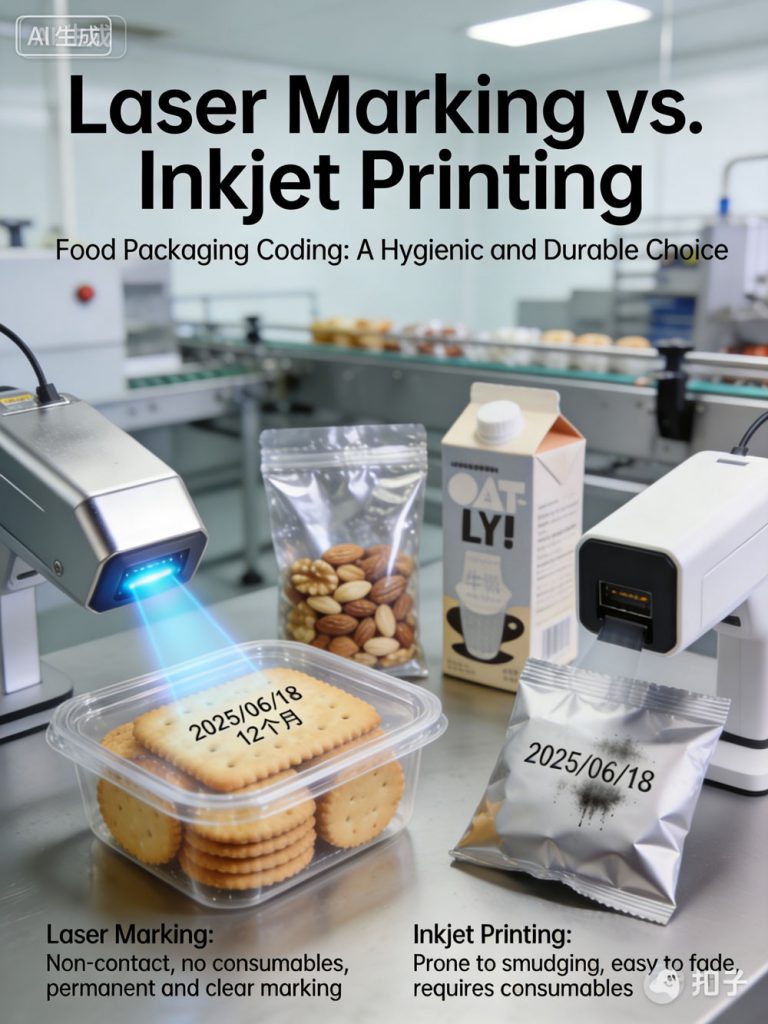
Laser wins on permanence. Etched codes resist abrasion, moisture, and chemical exposure — critical for frozen, refrigerated, or outdoor food products. By contrast, inkjet codes can fade or smear if not properly dried or protected.
Cost Considerations
For capital expenditure (CapEx), inkjet is generally more affordable. However, laser systems often deliver a lower operating expenditure (OpEx) due to no consumables and reduced maintenance. Over a 5-year lifecycle, lasers can be more economical in high-volume environments.
Production Speed
High-speed lines (e.g., snack foods, beverages) benefit from laser’s rapid marking without contact and minimal changeover. Advanced CIJ inkjet also achieves high speeds but with greater maintenance demands.
Environmental and Safety Factors
Laser coding has a sustainability edge — no inks or chemicals that need disposal. Inkjet printing, particularly with solvent-based inks, requires proper ventilation and waste management.
Flexibility
Inkjet printing offers more flexibility in substrate handling and color options. Laser systems typically excel on homogeneous materials but struggle on certain coatings or highly reflective surfaces without specific configurations.
Which Is Better? Context Matters
There is no one-size-fits-all answer. The “better” choice depends on key factors:
Choose Laser Coding When:
- You require permanent, high-resolution marks.
- Operating at industrial, high throughput levels.
- Running predominantly homogeneous, laser-compatible materials (glass, metals, many plastics).
- Long-term sustainability and cost efficiency are priorities.
Choose Inkjet Printing When:
- Upfront budget is limited.
- You need color printing or frequent design changes.
- Packaging materials vary widely and include surfaces less ideal for laser etching.
- Short runs and flexible marking positions are common.
Future Trends and Personal Insight
Several industry dynamics are shaping the future of food packaging coding:
- AI and Vision Systems: Coupling coding technology with real-time quality inspection will become standard.
- Digital Traceability: Unique digital identifiers printed at line will enable end-to-end tracking and consumer engagement.
- Sustainability Pressures: Laser systems will gain share due to reduced waste and energy efficiency.
Personal View: For mid-to-large food manufacturers aiming to future-proof operations, laser coding represents a strategic investment. Its durability and alignment with sustainability goals outweigh the higher initial cost. However, small producers or those with highly variable packaging formats will continue to benefit from the flexibility of inkjet systems.
Conclusion
Laser and inkjet technologies each serve vital roles in food packaging. Laser excels in permanence, low long-term cost, and sustainability, while inkjet offers upfront affordability, versatility, and color capability. Evaluation should focus on production volume, substrate types, regulatory needs, and total cost over time. Smart integration of either — or hybrid approaches in mixed lines — will ensure compliance, quality, and competitive advantage.