
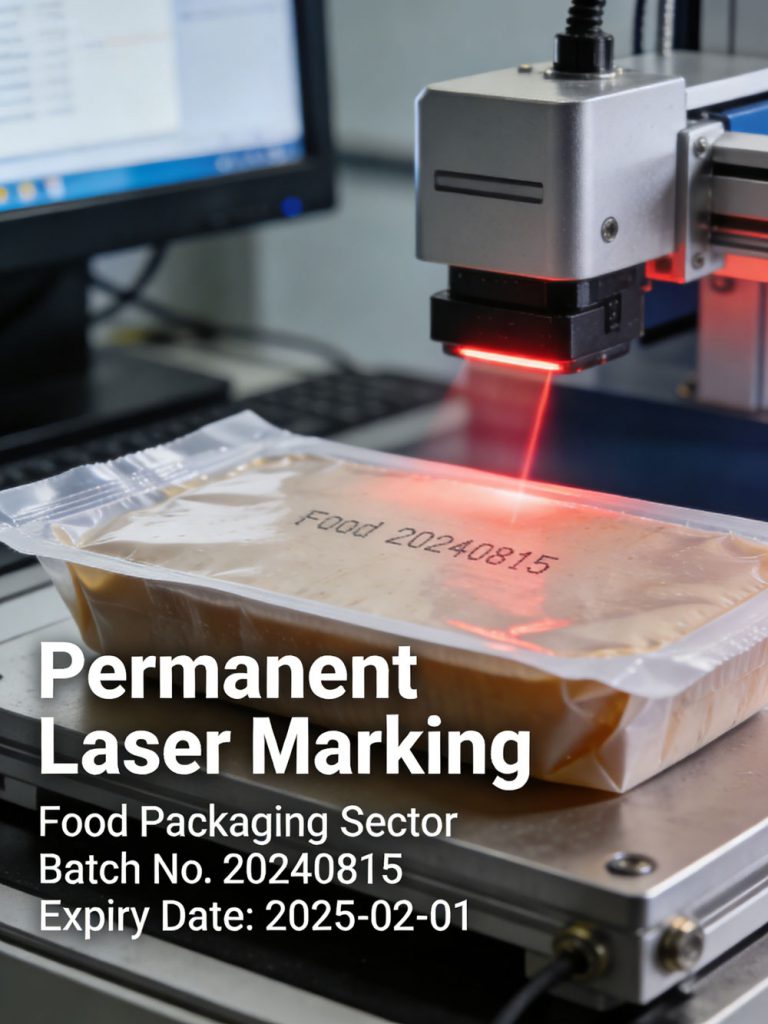
Permanent laser marking has rapidly evolved into a foundational technology for modern food packaging. It enables producers to embed essential product information—such as batch codes, expiration dates, regulatory details, traceability identifiers, and even serialized or anti-counterfeiting codes—directly onto packaging surfaces without consumables.
Contents
Why Laser Marking Is Increasingly Applied
In food manufacturing and packaging, the industry faces tougher regulatory demands, faster production speeds, and rising expectations for safety, traceability, and sustainability. Traditional ink-based or adhesive labeling methods struggle to meet these simultaneously: inks can smudge or fade, stickers can peel, and consumables generate waste. Laser marking addresses these challenges because the mark is produced through controlled material alteration rather than deposited substances—making it inherently permanent and contamination-free.
From an operational perspective, laser marking is contact-free and compatible with high-speed production lines. This eliminates the need for parts like print heads or ribbon consumables, reducing downtime and maintenance while improving throughput. It also supports traceability systems and automated vision inspection more reliably than many conventional methods.
Core Benefits Over Traditional Labeling
1. Permanent, High-Integrity Markings
Laser marks are physical modifications to a surface, making them resistant to moisture, heat, abrasion, and most transportation stresses. This longevity is especially valuable for products stored under refrigeration, freezing, or sterilization conditions, where labels and inks are prone to deterioration.
2. Hygiene and Safety Compliance
Since no ink, adhesive, or solvent is involved, laser marking eliminates contamination risks tied to chemical residues. In sectors such as infant formula, ready-to-eat meals, and beverages, this satisfies stringent food safety standards and aligns with hygienic design principles.
3. Enhanced Traceability and Anti-Counterfeiting
Laser marking supports the application of serialization, QR codes, unique identifiers, and nuanced textures that are extremely hard to replicate fraudulently. In a global market where food fraud and counterfeit packaging are persistent risks, this technology strengthens supply chain transparency.
4. Operational Efficiency and Lower Lifecycle Cost
While the initial investment in laser marking equipment may exceed that of basic inkjet printers, the total cost of ownership is lower due to zero consumables, less quality rework, and minimal maintenance needs. Many manufacturers report measurable improvements in production line uptime, speed, and consistency.
Materials and Packaging Types Supported
Laser marking can be applied to a broad range of packaging substrates found in the food industry:
- Rigid plastics and PET bottles: durable, suitable for beverages and sauces
- Glass containers and jars: ideal for premium and preservative packaging
- Paper and cardboard cartons: used for boxed foods and frozen products
- Metal lids and cans: resistant to corrosion and abrasion
- Flexible films and pouches: increasingly used for snack foods and fresh products
Each material demands careful selection of laser wavelength and system configuration to optimize contrast and readability without damaging the substrate.
Technology Variants and Their Roles
Laser marking equipment encompasses different core technologies, each suited to specific materials and applications:
- CO₂ and fiber lasers are widely used for marking plastics, glass, and metals with high contrast.
- Ultraviolet (UV) lasers operate at lower heat levels, which benefits delicate substrates such as thin films or sensitive coatings.
- High-precision systems are capable of micro-level details, enabling accurate QR codes and traceability marks even on very small surfaces.
Industry Trajectory and Strategic Importance
Market analyses show that the laser marking segment within food packaging is expected to grow significantly by the end of this decade, driven by global demand for reliable traceability systems, anti-counterfeiting measures, and greener packaging processes.
There is a clear shift toward label-free packaging, where information is directly marked on materials. This not only supports environmental goals—but also simplifies recycling and reduces material complexity in the waste stream.
Critical Considerations for Adoption
Despite the many advantages, producers must carefully evaluate:
- Upfront integration cost and compatibility with existing production lines
- Material-specific parameters for achieving optimal mark quality without damaging packaging
- Regulatory compliance in different markets (e.g., traceability mandates in the EU or FDA requirements in the U.S.)
- Training and expertise needed to maintain and calibrate laser systems
These factors often determine whether laser marking delivers the full expected ROI in a given operation.
Personal Insight
Laser marking in food packaging is not a fleeting trend but a strategic evolution in labeling technology. It aligns with the priorities of modern manufacturing—efficiency, sustainability, and authenticity. As global supply chains become more complex and regulatory scrutiny increases, permanent marking methods that enhance traceability and reduce waste are likely to become standard rather than exceptional.