
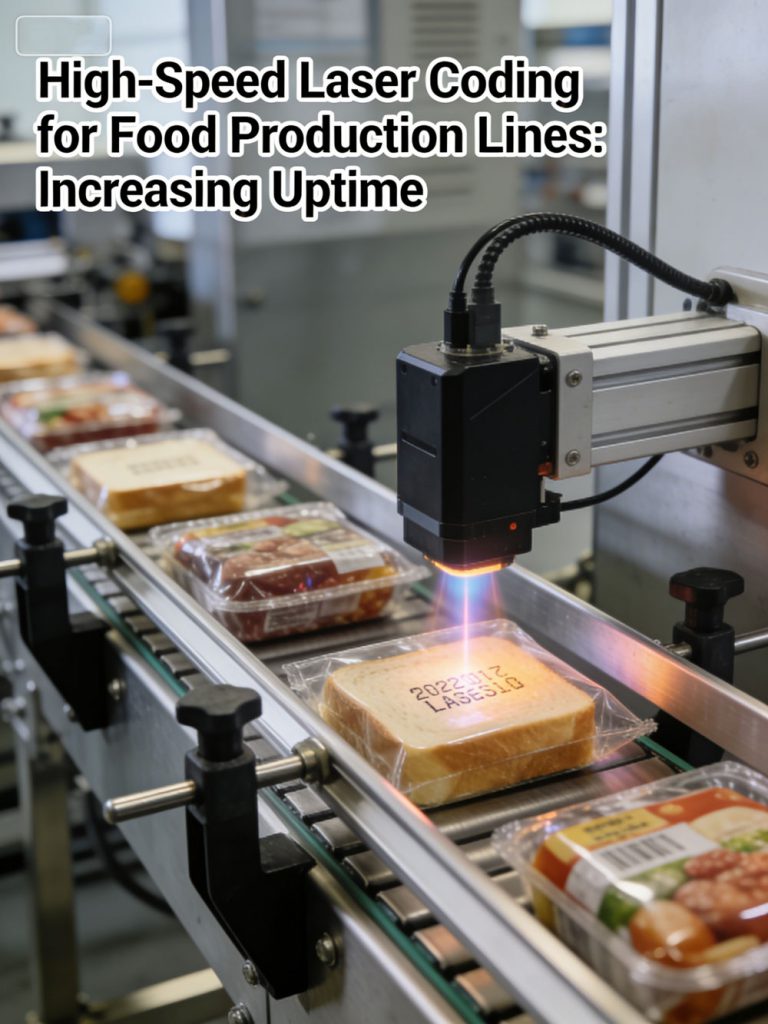
In today’s highly competitive food manufacturing environment, uptime and traceability are critical performance metrics. As consumer demand accelerates and regulatory requirements tighten, food producers are turning to advanced marking technologies to support faster lines, minimal waste, and robust traceability data. High-speed laser coding has emerged as a leading solution, enabling permanent, high-contrast marks at line speeds previously unattainable with traditional ink-based systems.
Contents
Industry Context: Why Coding Matters
Food production lines are among the most complex in manufacturing, processing a diversity of substrates — from flexible films and plastics to glass, metal, and cartons. Across these substrates, producers must reliably code:
- expiration and production dates
- lot and batch numbers
- barcodes and QR codes for traceability
- regulatory and compliance information
In global markets, traceability is not optional. Regulations in North America, Europe, and Asia increasingly mandate real-time, end-to-end traceability to improve food safety and reduce the impact of recalls. According to industry data, up to 70% of food recalls are tied to coding or labeling errors that impair traceability. These operational gaps not only risk consumer safety but also erode brand trust and inflate recall costs. Against this backdrop, coding technology has become a strategic asset — not just an operational requirement.
Challenges with Traditional Coding Methods
Conventional inkjet and thermal transfer printers have been staple technologies for years, but they present limitations on high-speed lines:
- Consumable dependency — inks, ribbons, and solvents require frequent changeovers and generate ongoing costs.
- Maintenance overhead — printhead clogging, ribbon breaks, and alignment issues cause unplanned downtime.
- Environmental sensitivity — moisture, vibration, and temperature changes can degrade printed codes, leading to poor readability in inspections or at retail.
- Limited durability — codes applied on wet, oily, frozen, or rough surfaces may smear or fade.
These factors contribute to unplanned downtime, quality defects, and rework — all of which reduce overall equipment effectiveness (OEE) and compress margins.
High-Speed Laser Coding: Uptime and Reliability
High-speed laser coding uses controlled laser energy to mark product surfaces by vaporizing or altering the material itself. This contact-free, consumable-free process delivers several uptime-oriented advantages:
1. Elimination of Consumables
Laser coding requires no ink, no ribbons, no solvents, and no cleaning fluids. This virtually eliminates supply chain dependencies related to consumables and removes a major source of line stoppages for refills or replacements.
2. Reduced Maintenance
Without printheads that clog or ribbons that tear, laser systems run longer between service intervals. Manufacturers report multi-shift uptime with minimal intervention, freeing technicians to focus on higher-value tasks.
3. Consistent Mark Quality at High Speed
Modern laser coders are engineered to maintain contrast and readability at line speeds exceeding 600 m/min. Whether coding dates on flexible film or high-density barcodes on cartons, laser marks resist abrasion, moisture, and environmental stresses.
4. Inline Process Integration
Laser coders integrate seamlessly with automated inspection and ERP/MES systems, supporting real-time verification and traceability. If a code fails inspection, the system can automatically divert the product, preventing defective units from advancing further in the line or reaching market.
Data-Driven Impact
Industry benchmarks show that facilities adopting high-speed laser coding can achieve:
- Up to 20% reduction in downtime related to coding and marking issues
- Up to 50% lower total cost of ownership over five years, due to the elimination of consumables and reduced maintenance
- Higher first-pass yield with fewer code reworks and rejects
These improvements directly elevate OEE, tighten production schedules, and minimize waste — outcomes that matter in a sector where margins are thin and consumer safety is paramount.
Sustainability Considerations
Beyond uptime, laser coding aligns with sustainability goals. Eliminating inks and ribbons reduces packaging waste and chemical disposal streams. For companies pursuing ESG targets — and for those subject to extended producer responsibility (EPR) regulations — this reduction in consumable waste is increasingly significant.
Personal Perspective
High-speed laser coding is not merely a technological upgrade; it represents a paradigm shift in food production line automation. In an era defined by digital traceability, lean operations, and sustainability commitments, laser coding elevates marking from a transactional task to a strategic differentiator. Manufacturers that invest in robust laser coding systems position themselves to enhance uptime, ensure compliance, and scale production without compromising quality.