Contents
Introduction
Laser marking on mirrors and mirror-like surfaces (including glass with reflective coatings or metal mirror surfaces) is technically challenging due to high reflectivity and low absorption of typical laser wavelengths. Selecting the right type of laser system isn’t just about picking a “powerful” machine — it’s about matching laser wavelength, pulse behavior, and the material’s optical and thermal properties.
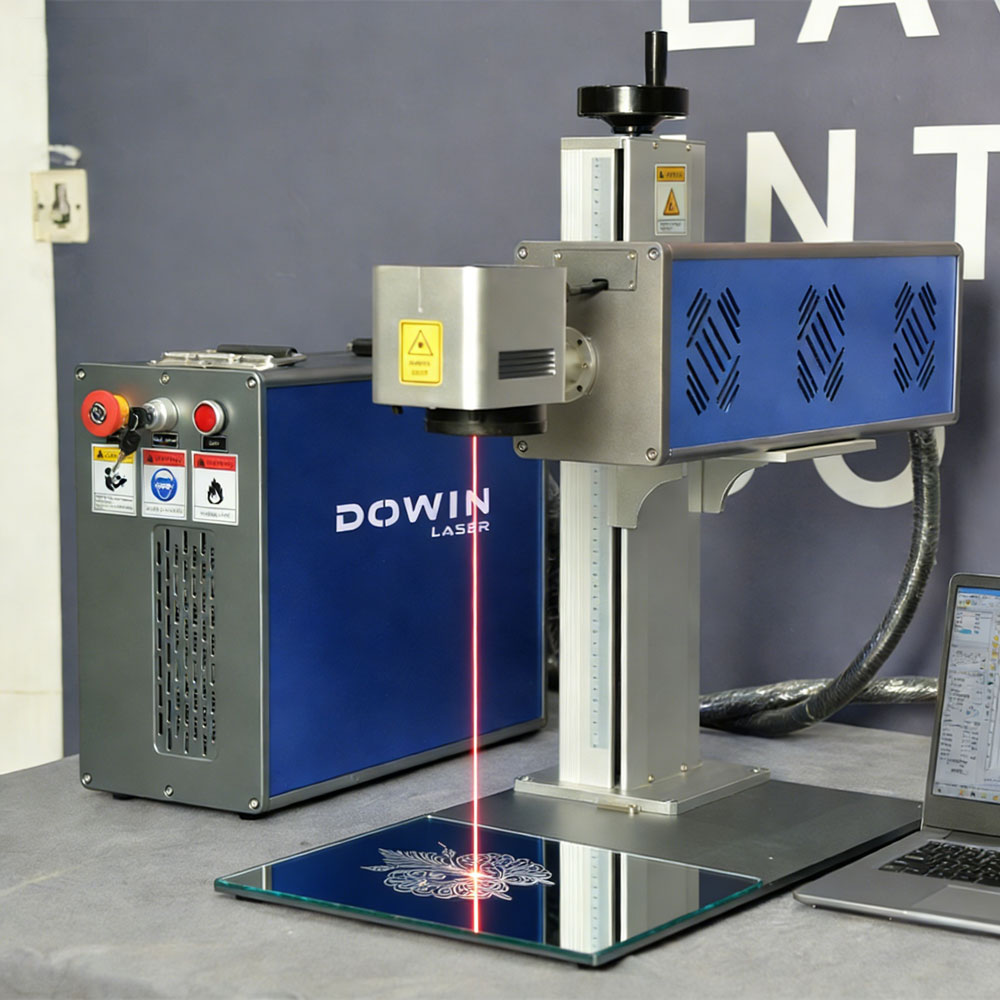
This analysis draws from industrial application data, material physics, and current market engineering consensus to define which technologies are effective for mirror marking and why.
Core Laser Technologies for Mirror Applications
📌 1. UV (Ultraviolet) Laser Marking Machines — Best for Glass & Coated Mirrors
Overview:
- UV lasers operate at short wavelengths (typically ~355 nm) and interact with materials via photochemical rather than purely thermal mechanisms.
- This leads to very low heat input and minimal thermal damage.
Material Suitability:
- Glass mirror surfaces and optical glass: Because the UV wavelength can be absorbed by glass and many coatings better than IR wavelengths, clean marks with high definition are possible.
- Precise, high-contrast logos and micro-marks are achievable without cracking or disturbing the mirrored coating.
Strengths:
- Cold marking with low heat distortion.
- Very fine resolution for detailed patterns.
Limitations:
- Relatively lower power and thus slower for deep engraving.
- Higher cost and less common than fiber or CO2 sources.
Best Use Cases:
- Glass mirrors with decorative graphics, serial numbers, or QR codes.
- Production where mirror integrity and optical quality are critical.
Personal Viewpoint:
For most mirror applications involving glass or coated optical surfaces, UV laser technology should be the first choice due to its material compatibility and minimal heat effects.
📌 2. CO₂ (Carbon Dioxide) Laser Marking Machines — Traditional but Effective for Glass
Overview:
- CO₂ lasers generate long wavelength radiation (~10.6 μm) that is well absorbed by non-metallic materials, including glass.
- They are widely used in industry for engraving and marking glassware and architectural components.
Material Suitability:
- Non-metallic mirror surfaces such as glass substrates.
- Can produce etched or frosted marks on mirror surfaces when the laser modifies only the very top layer.
Strengths:
- Strong performance for bulk glass marking — especially at scale.
- Lower cost relative to UV lasers.
Limitations:
- Less effective for metallic mirror coatings due to reflectivity.
- Produces more thermal effects than UV; surface halos or micro-cracks are possible if parameters aren’t controlled.
Personal Viewpoint:
CO₂ systems are a practical industrial compromise for glass mirror marking where the priority is throughput and cost rather than ultra-fine precision.
📌 3. Fiber Laser Marking Machines — Best for Metal Mirrors
Overview:
- Fiber lasers use a near-infrared wavelength (~1064 nm). They are industry standard for metal laser marking.
Material Suitability:
- Metallic mirror surfaces such as polished stainless steel, aluminum, chrome and other reflectively finished metals.
Strengths:
- Excellent for high-contrast marks on metal surfaces.
- Fast, durable, and efficient in industrial workflows.
Limitations:
- Not effective at directly marking glass or transparent mirror coatings without additional surface preparation (e.g., spray coatings).
- Strong reflection from mirror surfaces can damage the laser source if not properly managed.
Personal Viewpoint:
For metal mirrors, fiber laser systems are the most efficient and proven solution. However, their effectiveness on glass mirror substrates is limited without auxiliary surface treatments.
Practical Insights from Community and Industry Experience
Reflectivity & Safety Considerations
- Laser reflection from mirror surfaces (especially metal mirrors) can return energy into the laser head, potentially damaging it. This risk is non-negligible and requires proper safety strategies such as beam angle control or protective optical isolators.
Advanced Methods for Difficult Surfaces
- For applications where direct absorption is low (e.g., clear glass or high-reflectance metals), industrial practitioners sometimes use:
- Auxiliary coatings / spray agents that improve surface absorption (especially with non-UV lasers, though results vary and coatings may affect quality).
- Mechanical surface prep before laser processing.
Comparative Summary
| Laser Type | Best at | Typical Materials | Pros | Cons |
|---|---|---|---|---|
| UV Laser (355 nm) | High-precision glass & coated mirrors | Glass, optical materials | Minimal heat damage, very fine marks | Higher cost, slower |
| CO₂ Laser | Glass and non-metallic marking | Glass, ceramics | Cost-effective, widely used | Thermal effects, less precision |
| Fiber Laser (1064 nm) | Metallic mirrors | Metals | Fast, high contrast on metals | Limited for glass, risk of reflection |
Final Recommendations (Engineering Perspective)
- Glass & Optical Mirrors (high value) — Use a UV laser system to avoid heat damage and maximize mark fidelity.
- Industrial Glass Etching at Scale — CO₂ lasers provide a balance of cost and throughput for moderate detail.
- Metallic Mirror Surfaces — Fiber lasers deliver the best results on polished metals, provided reflection is safely managed.
In general, matching the laser wavelength to material optical properties is more important than simply buying a higher power machine. This principle, supported by both manufacturer specifications and practitioner experience, ensures the most reliable mirror-marking outcomes.