
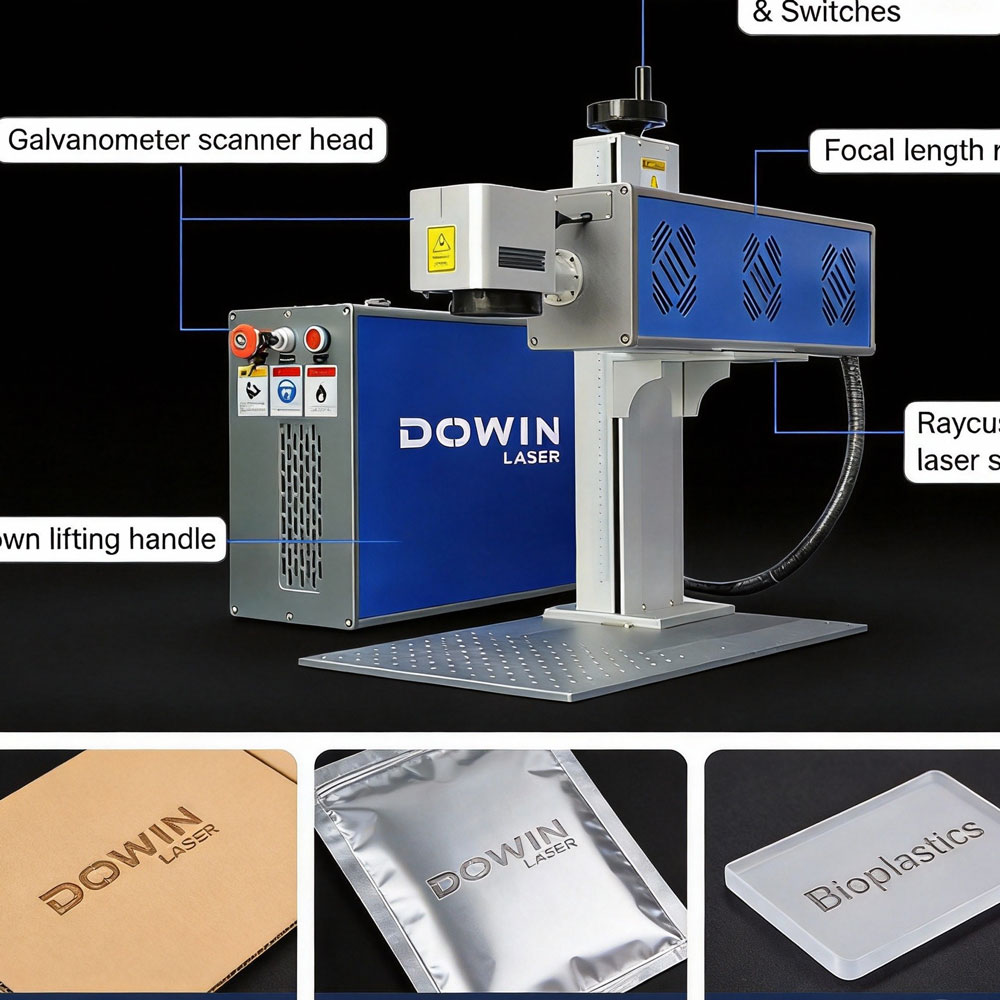
Laser marking is no longer a niche technology reserved for metals and hard plastics. As global manufacturing shifts toward sustainable packaging, shorter production cycles, and stricter traceability requirements, laser marking on cardboard, foil, and bioplastics has become a strategic tool rather than a technical alternative. This guide deliberately breaks away from traditional explanations and explores how laser marking is reshaping modern packaging—both technically and commercially.
Contents
- 1 Why Laser Marking Is Redefining Packaging Identification
- 2 Laser Marking on Cardboard: Precision Without Ink
- 3 Laser Marking on Foil: Permanent Codes on Reflective Surfaces
- 4 Laser Marking on Bioplastics: Where Sustainability Meets Technology
- 5 Beyond Marking: Lasers as a Digital Packaging Platform
- 6 Cost, Efficiency, and Long-Term ROI
- 7 Breaking the Old Logic: Why “Print First” No Longer Applies
- 8 Final Thoughts: The Future Is Marked by Light
Why Laser Marking Is Redefining Packaging Identification
Conventional printing methods rely on inks, solvents, labels, and consumables. They add cost, maintenance, and environmental burden. Laser marking, by contrast, introduces a non-contact, digital, and permanent marking process that integrates directly into production lines.
From an industry-wide perspective, three macro trends are driving adoption:
- Regulatory pressure on food, pharmaceutical, and cosmetic packaging traceability
- Sustainability mandates reducing chemical inks and disposable labels
- High-mix, low-volume production requiring instant design changes without downtime
Laser marking meets all three with a single technology stack.
Laser Marking on Cardboard: Precision Without Ink
Cardboard may look simple, but it is structurally complex—composed of fibers, fillers, coatings, and recycled materials. Laser marking interacts with these layers through controlled carbonization or surface foaming.
Key Advantages
- Clear, high-contrast text and QR codes
- No ink migration or smudging
- Excellent readability for logistics and retail scanning
Technical Considerations
- CO₂ lasers are typically preferred due to strong absorption by cellulose
- Power and speed must be balanced to avoid burn-through
- Coated or laminated cardboard requires parameter optimization
Real-World Applications
- E-commerce shipping boxes
- Food and beverage outer packaging
- Variable data marking for batch and date codes
Laser marking transforms cardboard from a disposable surface into a data carrier.
Laser Marking on Foil: Permanent Codes on Reflective Surfaces
Foil packaging—especially aluminum—is widely used for pharmaceuticals, coffee, snacks, and blister packs. Traditional ink printing often struggles with adhesion and durability on metallic surfaces.
Laser marking solves this by inducing micro-oxidation or surface color change rather than material removal.
Why Lasers Outperform Ink on Foil
- Marks resist heat, abrasion, and chemicals
- Zero risk of ink contamination
- Consistent quality at high line speeds
Laser Types and Strategy
- Fiber lasers are ideal for aluminum foil
- Low-energy marking preserves foil integrity
- High-speed galvo systems support continuous production
In regulated industries, laser-marked foil offers compliance-grade permanence.
Laser Marking on Bioplastics: Where Sustainability Meets Technology
Bioplastics introduce a new challenge. Their formulations vary widely—PLA, PHA, starch blends—each responding differently to laser energy. This variability has discouraged traditional marking methods.
Laser marking turns this weakness into an advantage.
Benefits for Bioplastic Packaging
- No chemical additives or solvents
- Compatible with compostable and bio-based materials
- Supports eco-labeling and transparency initiatives
Process Optimization
- UV and fiber lasers deliver fine control with minimal thermal impact
- Color contrast can be enhanced through foaming instead of burning
- Parameter testing is essential due to material diversity
Laser marking enables bioplastics to remain truly sustainable, from production to disposal.
Beyond Marking: Lasers as a Digital Packaging Platform
The real disruption is not the mark itself—it is what the mark enables.
Laser systems integrate seamlessly with:
- MES and ERP systems
- Vision inspection and AI-based verification
- Real-time serialization and anti-counterfeiting
This turns packaging into a dynamic interface for data, compliance, and brand trust.
Cost, Efficiency, and Long-Term ROI
While laser systems require upfront investment, long-term data shows clear economic advantages:
- Elimination of inks, cartridges, and maintenance downtime
- Reduced line stoppages for design changes
- Lower total cost of ownership over multi-year operation
In high-volume or regulated environments, lasers quickly shift from “cost center” to profit protector.
Breaking the Old Logic: Why “Print First” No Longer Applies
The packaging industry was built on the assumption that marking equals printing. That assumption no longer holds.
Laser marking is:
- Cleaner than ink
- Faster than labels
- Smarter than static printing
It aligns with modern manufacturing logic: digital, flexible, and sustainable.
Final Thoughts: The Future Is Marked by Light
Laser marking on cardboard, foil, and bioplastics is not an incremental upgrade—it is a structural change in how packaging communicates. As materials evolve and regulations tighten, lasers offer something no ink ever could: permanent clarity without compromise.
Manufacturers who adopt laser marking today are not just improving efficiency—they are redefining how packaging works in a data-driven, sustainability-focused world.