
Aluminum is among the most widely used engineering metals on earth: lightweight yet strong, corrosion-resistant, and central to industries from aerospace and automotive to consumer electronics and medical devices. Global aluminum production has climbed steadily over the past decade to meet rising demand for electrification, lightweight structures, and sustainable engineering solutions. With this ubiquity comes a universal need—how to permanently and reliably mark aluminum parts for identification, traceability, regulatory compliance, and branding.
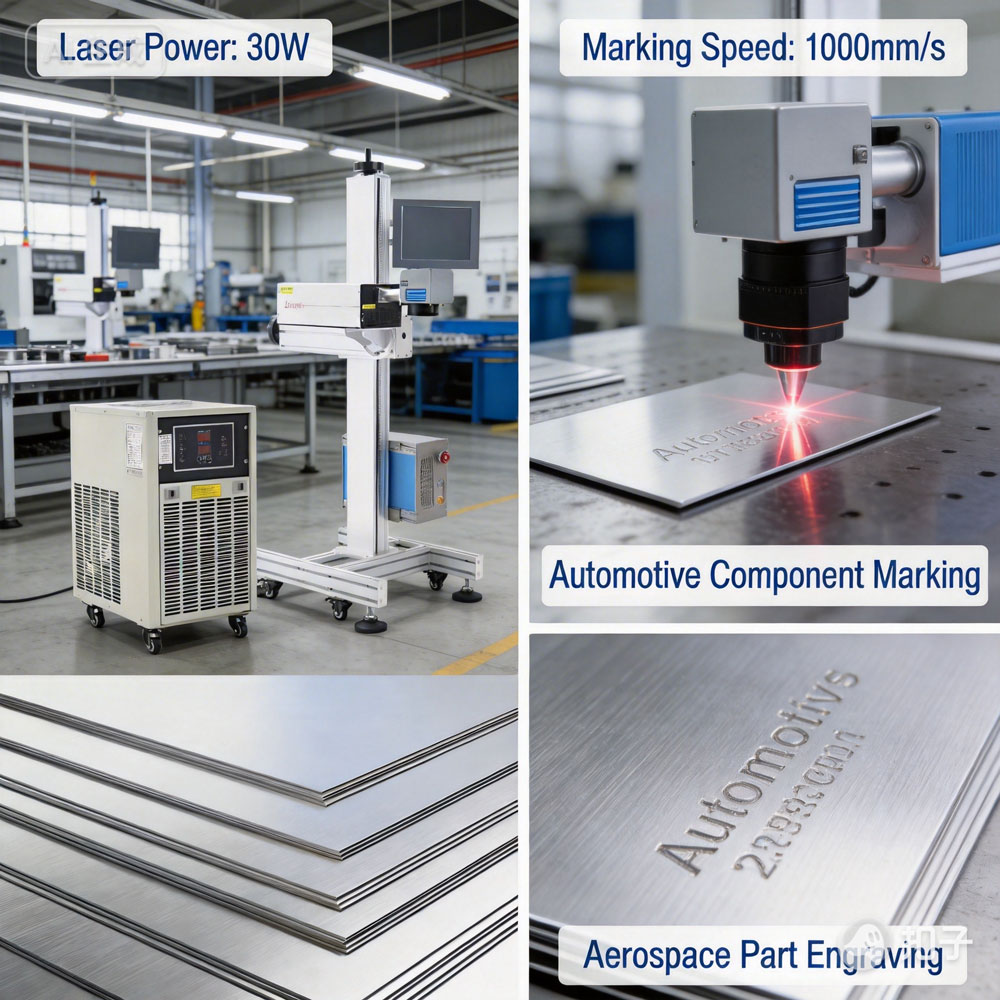
Laser marking and engraving technologies have emerged as the dominant solutions, displacing older mechanical, chemical, and ink-based processes. In high-precision manufacturing environments, the stakes are not trivial: even slight imperfections in part identification can cascade into safety risks, failed traceability audits, or downstream failures.
This article explores how laser technology addresses these demands, why it’s becoming standard practice, and where industry trends are pushing capabilities next.
Contents
Why Laser Marking Dominates Aluminum Processing
1. Non-Contact Precision Preserves Structural Integrity
One of the defining advantages of laser marking is that it is non-contact. Traditional methods — stamping, dot-peen, chemical etching — touch or chemically alter the surface, often leaving micro-stress points, scratches, or subtle distortions. Laser systems eliminate this risk entirely because there is no physical force applied to the part being marked. This matters enormously in applications where structural performance is critical — aircraft components, engine parts, precision instruments, or critical medical implants.
Because the material isn’t mechanically stressed, the mechanical properties of aluminum remain unchanged, which is why laser marking is the go-to technology for high-reliability sectors.
2. Permanent, High-Contrast Markings Across Conditions
Laser marking works by altering or removing a thin surface layer of aluminum — either through vaporization, oxidation, or precise ablation — to create high-contrast marks that are permanent and exceptionally resistant to wear, heat, corrosion, and chemical exposure. This permanence far surpasses ink, paint, or adhesive labels, which are prone to degradation and loss over time.
Practically, manufacturers use laser markings for:
- Serial numbers and production codes
- 2D matrix and QR codes for automated traceability
- Logos and branding elements
- Regulatory and compliance text that must survive harsh environments
The result is not only readability but also long-term legibility throughout the product lifespan.
3. Versatility Across Aluminum Types and Surface Finishes
Laser marking adapts effortlessly to different aluminum conditions:
- Anodized Aluminum – The thin oxide layer interacts with laser energy to produce very high contrast between marked and unmarked areas, making codes and graphics easy to scan or visually inspect.
- Bare Aluminum – With tuned laser parameters, bare aluminum can be etched for readable marks, although the contrast is naturally more subtle than on anodized surfaces.
- Powder-Coated or Treated Surfaces – Lasers can precisely remove top layers without damaging underlying structure.
This universality simplifies production workflows, reducing the need for multiple marking systems to accommodate different product lines.
4. Speed, Automation, and Integration with Modern Manufacturing
Laser marking systems are engineered for seamless integration into high-volume production lines. They can operate continuously with minimal downtime, require no consumables (ink, solvents, or templates), and can be synchronized with conveyors, robotics, vision-inspection systems, and digital tracking infrastructures. Real-time data from ERP, MES, or scanning systems can dynamically drive marking content — e.g., unique identifiers per item on the fly.
The advantages are quantifiable:
- Reduced cycle times
- Higher throughput
- Lower maintenance costs
- Fewer production interruptions
This makes laser marking a cornerstone technology in Industry 4.0 and next-generation digital factories.
Shifting Paradigms: Beyond Standard Identification
Laser marking’s evolution isn’t just about speed or durability — it’s also about functionality and intelligence.
Advanced Marking for Data-Rich Ecosystems
In regulated domains like aerospace or medical devices, markings must sometimes meet standardized readability and quality thresholds (e.g., ISO/IEC requirements). Laser systems paired with machine vision can grade codes in real time, ensuring that every etched DataMatrix or QR code passes inspection before moving down the line.
This combination of laser marking and embedded verification is fundamental to fully traceable digital supply chains.
Material Science Meets Precision Manufacturing
Laser interaction with aluminum isn’t just about surface etching — it’s becoming a tool for tailored material modification. Research on ultrafast lasers and surface processing shows the potential for nanoscale surface engineering, enabling enhanced emissivity, anti-counterfeiting microstructures, and texturing that can change functional properties like friction or thermal behavior.
These emerging capabilities blur the lines between marking and functional surface engineering — signaling a future where laser processes will add value far beyond identification.
Strategic Takeaways for Industry Leaders
Laser marking on aluminum has completed its transition from “nice-to-have” to mission-critical infrastructure in manufacturing. When evaluating marking strategies, consider:
- Lifecycle Requirements: Permanent vs. temporary marks
- Traceability Complexity: 2D codes and automated inspection demands
- Environmental Exposure: Corrosion, heat cycles, and chemical resistance
- Production Scale: Inline automation versus standalone operations
- Digital Integration: ERP/MES linkage and closed-loop quality control
Laser marking isn’t just a technology choice — it’s a strategic pillar for modern product quality, compliance, and traceability.