
In the modern industrial landscape, part identification and traceability are no longer optional extras — they are foundational requirements across aerospace, automotive, medical devices, and advanced manufacturing. Traditional laser marking systems handle flat surfaces with precision, but when production involves cylindrical or curved geometry, a distinct technology is required: the rotary laser marking machine.
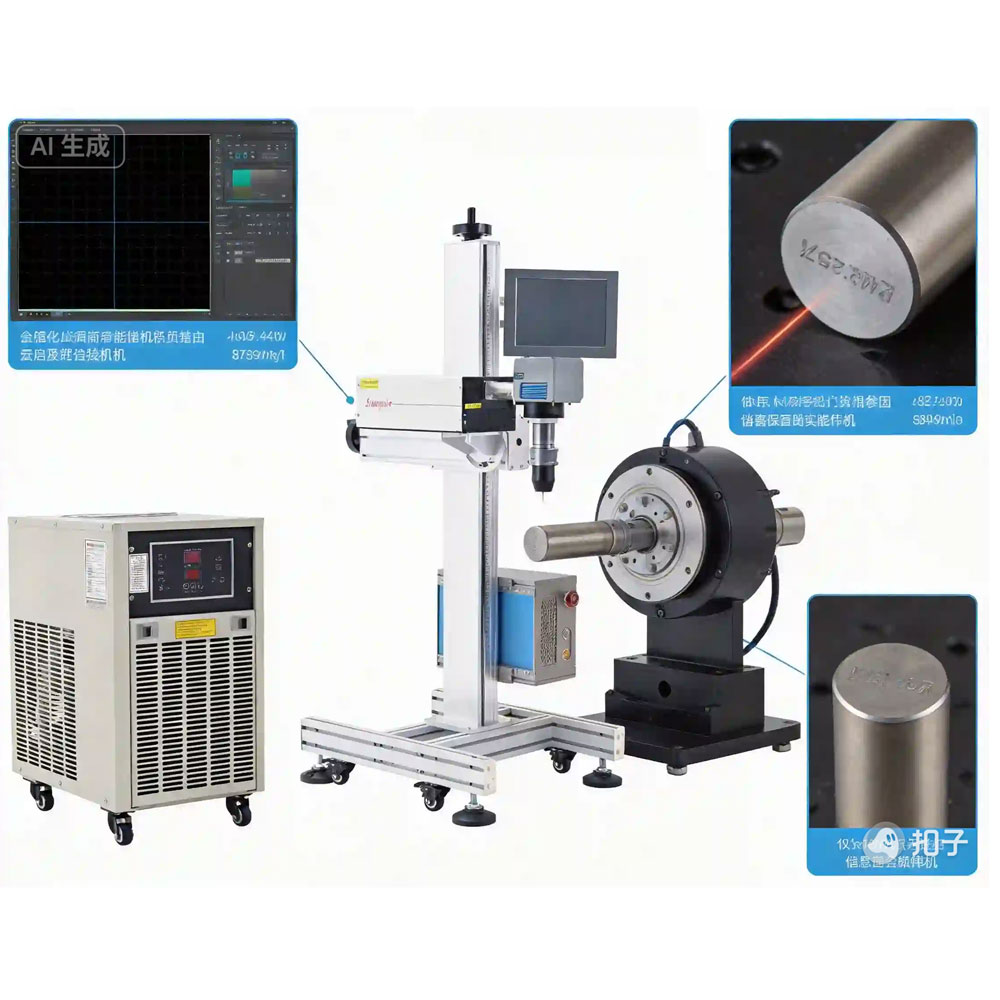
A rotary laser marking solution integrates a rotating fixture or axis with the laser system, enabling 360-degree marking around a part’s surface while preserving industrial-grade speed and repeatability. This configuration shifts laser marking from a flat-plane process into a fully three-dimensional operation, unlocking accuracy and throughput previously achievable only with expensive multi-axis robots or slow manual changeovers.
Contents
The Industrial Context: Why Rotary Matters Now
Contemporary manufacturing is shaped by two converging trends:
- Diversification of product shapes and materials: Components are increasingly complex — tubes, shafts, medical implants, precision fasteners, and even customized consumer items all feature non-flat surfaces requiring permanent marks for traceability and compliance.
- Demand for speed and automation: Automated production lines no longer tolerate slow marking steps. Manufacturers are measured on cycle times and overall equipment effectiveness (OEE); each second saved contributes directly to profitability.
In this context, rotary laser marking machines solve a dual problem: they combine precision accuracy with industrial throughput, and they do so without sacrificing quality across curved geometries that flat lasers struggle to address efficiently.
How Rotary Laser Marking Works
A rotary laser marking system essentially adds a controlled rotational axis to a standard laser marking setup. Instead of the laser head sweeping over a stationary object, the object rotates under the laser while the beam marks around its circumference. Precise synchronization between the rotary motion and the laser pulse ensures uniformity of the marking pattern.
This method is vastly superior to manual repositioning or fixtures that attempt to approximate curved surfaces, because:
- It eliminates human repositioning errors.
- It provides even energy delivery around the full rotation.
- It maintains consistent focal distance, regardless of part geometry.
Higher-end systems may also include auto-focusing subsystems, which dynamically compensate for concentricity variation and part geometry tolerances, ensuring repeatable results even on parts with slight shape deviations.
Advantages That Translate to Competitive Edge
1. True 360-Degree Marking Without Compromise
Rotary attachments allow continuous marking around cylindrical parts without the typical segmentation or seam artifacts that plague less advanced technologies. This is essential for brand identifiers, regulatory codes, and traceability markings — all of which must be readable and uniform regardless of where they sit on a part’s circumference.
2. Precision and Consistency at Scale
By synchronizing part rotation and laser emission, rotational laser systems produce marks with micron-level fidelity, even on complex contours. This level of precision is not a luxury — it is required when marking 2D codes, serial data, and micro-text, which must be legible by automated vision systems downstream.
3. High Throughput in Automated Environments
Rotary setups are designed to overlay marking with other production steps. In many configurations, while one part rotates and is marked, another part can be loaded or unloaded — maximizing utilization of robot time and reducing idle cycles. This throughput optimization is often cited as a key reason manufacturers adopt rotary over flat-bed marking systems.
4. Wide Material Compatibility
Though often associated with metal parts, rotary laser marking has proven adaptable across materials like plastics, ceramics, and composites. The technology retains the non-contact, non-wear benefits of all laser marking, meaning minimal substrate stress and long-lasting quality — a crucial differentiator for regulated industries like medical and aerospace.
Real-World Applications
The versatility of rotary laser marking means it is no longer confined to one niche. Key industrial use cases include:
- Automotive and Aerospace: Serial numbers, part identifiers, and quality traceability marks on shafts, bushings, and tubing that must endure high heat or vibration.
- Medical Devices: Permanent marks on surgical instruments and implants where cleanability and lifecycle traceability are critical.
- Consumer Goods: Personalized or decorative markings on cylindrical products like drinkware or tech accessories.
- Industrial Components: Batch codes, barcodes, and compliance data on fasteners, fittings, and tooling elements that require 360° visibility.
This breadth of use demonstrates that rotary laser marking is not a fringe technology — it is now core infrastructure for modern manufacturing identification.
Strategic Considerations Before Adoption
While the benefits are clear, successful implementation requires evaluating:
- Part Size & Geometry: Ensure the rotary system can accommodate the maximum diameter and length.
- Marking Requirements: Do your marks need ultra-high resolution (e.g., for micro-text or dense data codes)?
- Automation Strategy: Do you plan full integration with conveyors or robotics, or will the system be semi-automated?
- Material Mix: Some materials interact more predictably with certain laser wavelengths and power levels.
Assessing these factors upfront avoids under-sized systems or unnecessary hardware complexity that can impede ROI.
Final Perspective: Confidence Through Precision
Rotary laser marking machines represent a vital evolution in industrial marking technology. They extend the power and precision of lasers from flat planes to fully rotational surfaces, closing a capability gap that has historically slowed production innovation. In a world where traceability, automation, and quality are non-negotiable, the ability to reliably and rapidly mark curved parts is more than a technical advantage — it is a strategic differentiator for manufacturers competing on global scales.