
In modern manufacturing, plastic sheets are everywhere — from semiconductor packaging and medical kit trays to aircraft interior panels and consumer products. With global production of plastics topping hundreds of millions of tonnes per year, their use is essential in sectors prioritizing strength, lightness, and cost-efficiency. However, ubiquitous materials require equally sophisticated methods for identification, traceability, and safety marking that last as long as the products themselves. This is where laser engraving on plastic sheets has rapidly matured from “nice-to-have” technology to a standard industrial practice.
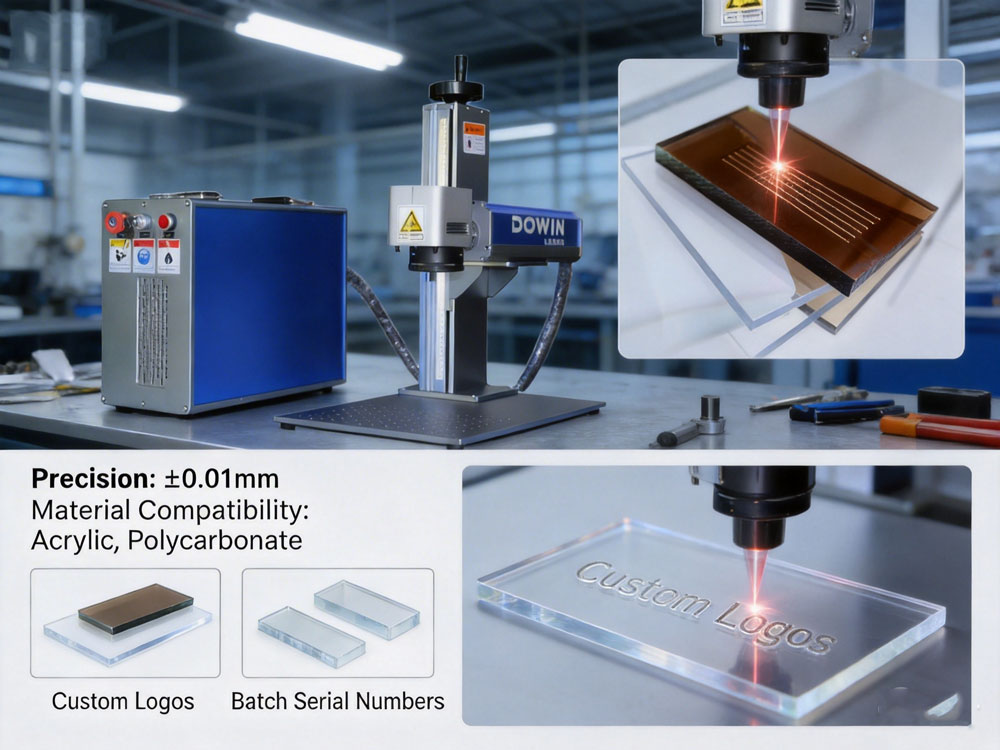
Laser engraving is not merely another way to engrave text or logos onto plastic. It represents a fundamental shift toward more precise, reliable, and automated marking that keeps pace with modern manufacturing demands — including data traceability, regulatory compliance, and integration into digitalized production lines.
Contents
- 1 What Happens When a Laser Meets Plastic Sheets?
- 2 Choosing the Right Laser for Plastic Sheets
- 3 Why Laser Engraving Beats Traditional Methods
- 4 Practical Use Cases That Showcase the Value
- 5 Strategic Perspective: Where the Technology Is Heading
- 6 Conclusion: Laser Engraving as Smart Manufacturing Infrastructure
What Happens When a Laser Meets Plastic Sheets?
Laser engraving plastic involves using a high-intensity light source to alter the surface of a plastic sheet. Depending on the laser wavelength and power settings, the machine can either vaporize microscopic regions of the material or induce surface reactions that change colour or texture. Since there is no physical contact and no mechanical tool wear, plastic deformation — a risk with traditional rotary or tip-based engraving — is virtually eliminated.
Key outcomes of the process include:
- Permanent surface modification: The marks do not peel, fade, or flake off, making them ideal for long-lifecycle parts.
- No tooling cost or consumables: Unlike ink, stamps, or chemical etches, laser engraving only requires electricity, offering low ongoing operating expense.
- High automation potential: Laser systems integrate readily with conveyors, vision inspection, and data systems, enabling high throughput and minimal manpower per unit.
This moves engraving away from artisanal or small-batch processes and into industrial-grade production where speed and repeatability are non-negotiable.
Choosing the Right Laser for Plastic Sheets
Not all lasers behave the same when interacting with polymers. Plastic’s heat sensitivity and optical characteristics mean that careful selection of the laser type directly influences quality, contrast, and durability.
Three principal approaches dominate industrial practice:
- Ultraviolet (UV) Lasers:
These operate at very short wavelengths, often described as “cold marking” because they disrupt material at a molecular level without significant heating. This is critical for plastics that would otherwise melt or warp with heat. UV lasers deliver high contrast while preserving dimensional stability. - Hybrid Lasers:
Combining multiple laser technologies into a single system produces high peak power capable of engraving deeper channels into plastic without transferring damaging heat to surrounding material. This balance of power and temperature control is ideal for rugged industrial marking. - CO₂ Lasers:
These longer-wavelength lasers rely on heat to engrave and are excellent for thicker or thermally robust plastics. Their deeper engravings are visible even under coating or surface treatments and are often used where depth and durability trump minimal thermal impact.
Selecting the right laser is not trivial: mismatches can lead to poor contrast, heat damage, or deformed sheets — outcomes that undermine product quality or traceability. Understanding material properties (e.g., thermoplastic vs. thermoset, pigment content, thickness) is essential for successful implementation.
Why Laser Engraving Beats Traditional Methods
Compared with mechanical engraving, ink printing, or chemical etching, laser engraving offers distinct advantages that align directly with industry needs:
- Speed and throughput: Laser systems can mark plastic sheets in fractions of a second, ideal for high-volume production.
- Non-contact precision: There is no tooling pressure, eliminating surface stress and deformation common in mechanical methods.
- Environmental sustainability: Without inks, chemicals, or consumables, laser engraving produces minimal waste and lower environmental impact.
- Resistance to environmental conditions: Laser marks withstand abrasion, heat, and chemical exposure better than ink or label alternatives, which can fade or peel.
This combination of features is especially compelling for applications where traceability and durability are mission-critical, such as medical device identification, aerospace components, and semiconductor packaging.
Practical Use Cases That Showcase the Value
Laser engraving plastic sheets is gaining ground across diverse sectors — but some applications illustrate the broader strategic shift in manufacturing:
Semiconductor Packaging
Plastics protect electronic devices from contaminants, but visibility of manufacturing codes and serial numbers is crucial for quality tracking. Laser engraving addresses this by creating permanent, readable markings that survive handling and environmental stress.
Aircraft Interiors
Lightweight plastic sheets are standard in cabin interiors due to their strength-to-weight ratio. Laser-engraved safety and compliance labels endure cleaning, UV exposure, and pressure changes without degradation — essential for aviation safety.
Medical Tray Seals and Regulatory Marking
FDA regulations require unique device identifiers (UDIs) on medical components. Laser engraving delivers permanent codes that remain legible through sterilization and transport, ensuring compliance without damaging sensitive materials.
These examples demonstrate that laser engraving has become an integral tool not just for marking, but for embedding digital traceability and regulatory assurance into products.
Strategic Perspective: Where the Technology Is Heading
Laser engraving on plastic sheets is not a static technology. Advancements in laser sources, automation, and material-specific processing are converging with broader trends in manufacturing:
- Industry 4.0 integration: Marking systems are paired with databases, vision inspection, and automated quality loops that reduce error rates and improve traceability.
- Smart manufacturing: Dynamic marking — such as on-the-fly serialization — is now part of digital supply chains that demand real-time data capture.
- Material innovation: New polymers and composites tailored for performance are also being engineered to interact predictably with laser wavelengths, enabling higher contrast and functional surface structuring.
A strategic viewpoint suggests that laser engraving will continue shifting from a marking tool to a material processing platform capable of contributing to quality, traceability, and product identity across the lifecycle.
Conclusion: Laser Engraving as Smart Manufacturing Infrastructure
Laser engraving on plastic sheets is more than a marking technique — it is infrastructure for modern industrial operations. Its combination of permanence, speed, non-contact precision, and adaptability to automated environments makes it indispensable for sectors where traceability, durability, and compliance are essential.
With plastics dominating so many engineered products, adopting laser engraving is not just a quality improvement; it is a competitive necessity in markets where product identity and lifecycle visibility drive value.