
Laser technology has evolved from niche scientific tools to indispensable instruments across manufacturing, aerospace, medical devices, electronics, and more. At the heart of every laser marking, engraving, welding, or cutting system lies a deceptively simple specification: laser power. Yet, interpreting this number correctly — and understanding how it interacts with laser pulse dynamics and materials — separates well-implemented production systems from poorly performing ones.
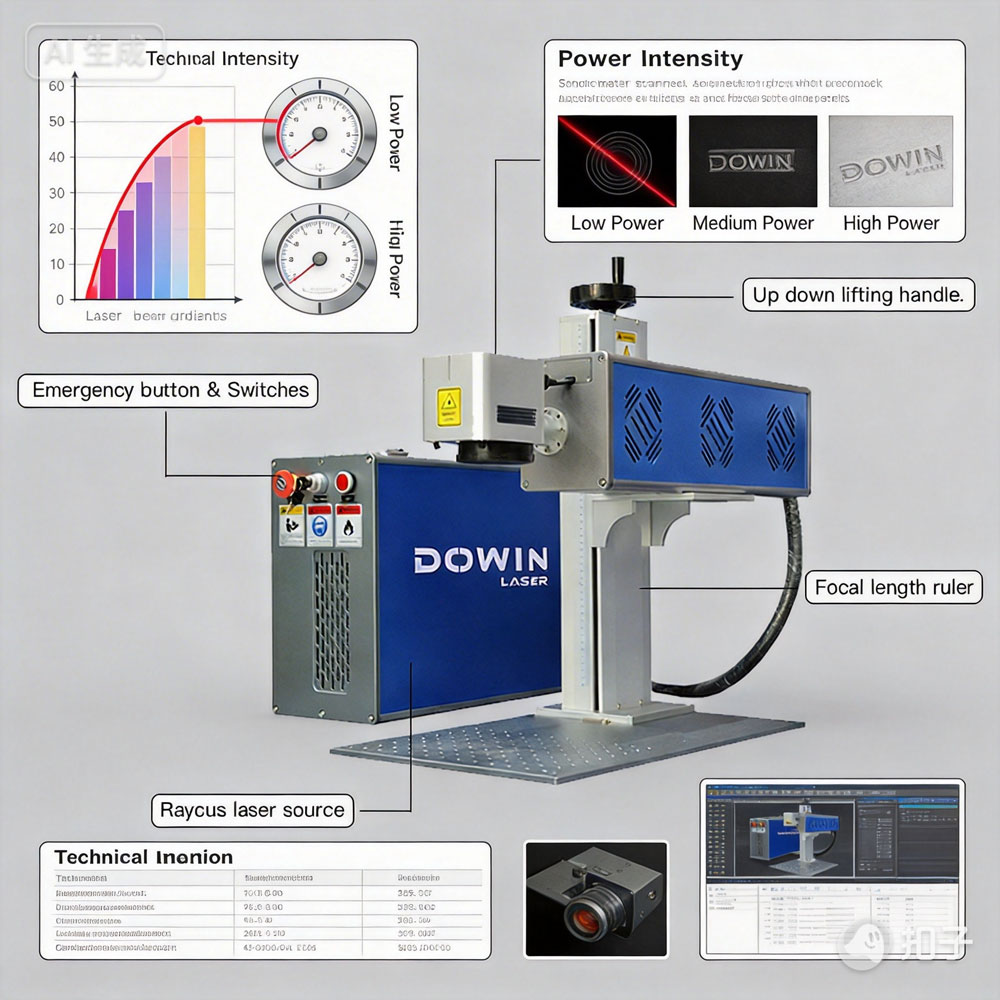
Too often, engineers and procurement professionals assume “higher wattage = better performance.” In reality, optimal laser performance depends on a matrix of interacting parameters that calibrate energy delivery to material behavior and desired outcomes. This article distills the fundamentals and explains why power alone doesn’t tell the whole story.
Contents
- 1 What Does “Laser Power” Really Mean?
- 2 Beyond Watts: Pulse Dynamics
- 3 The Critical Role of Beam Characteristics
- 4 Continuous vs. Pulsed Operation
- 5 Industry Applications: How Power Choices Matter
- 6 Practical Laser Power & Pulse Matrix by Material
- 7 Quick Selection Guide (Decision Shortcut)
- 8 Strategic Insights: Choosing the Right Power
- 9 Final Thoughts: Rethinking “Power” in Laser Systems
What Does “Laser Power” Really Mean?
In technical discussions, laser power usually refers to average power — the total energy emitted per unit time, typically measured in watts (W). A 100 W laser delivers 100 joules of energy each second, regardless of pulse structure. However:
- Average power describes how much energy is available.
- Peak power describes how intensely that energy is delivered in a short burst.
- Power density indicates how concentrated that energy is over a specific area.
These metrics together define how effectively a laser can mark or process a surface. For example, a device with moderate average power but tight beam focus can outperform a high-wattage system with a large spot size because it drives higher energy density.
Beyond Watts: Pulse Dynamics
Pulse Energy
Pulse energy is the energy of a single burst of light. In pulsed lasers, a short, high-energy pulse can remove or alter material more cleanly than a constant beam. For example, a lower-wattage UV laser may outperform a higher-wattage IR laser in marking certain plastics because its shorter wavelength and pulse structure interact more effectively with that material’s absorption characteristics.
Pulse Duration
Pulse duration — the length of time each pulse lasts — directly affects peak power. Shorter pulses concentrate energy into tighter time windows, increasing peak intensity without increasing average power. A 25 W laser with ultra-short pulse duration can achieve greater peak power and finer precision than a 100 W laser with longer pulses.
Pulse Repetition Rate
The pulse repetition rate (measured in kHz or Hz) defines how many pulses a laser emits per second. A system with a high repetition rate can process material rapidly, but increasing pulses usually requires reducing individual pulse energy unless average power is increased — another balancing act.
The Critical Role of Beam Characteristics
Spot Size and Power Density
Energy distribution within the beam matters. A smaller spot size concentrates power into a compact area, producing higher power density and enabling deeper engraving or cutting. This explains why a “lower-power” device with a refined beam focus can outperform a “higher-power” unit with a broad, diffused beam.
Power density — energy per unit area — is often more meaningful in marking applications than raw power. Prioritizing spot size and beam quality can drastically improve mark contrast, speed, and consistency, particularly on complex materials.
Continuous vs. Pulsed Operation
Laser systems can operate in two fundamental ways:
- Continuous Wave (CW): Delivers steady, uninterrupted output. CW lasers are suited for tasks like cutting and welding where consistent power drives material removal or fusion.
- Pulsed: Releases energy in discrete bursts. Pulsed operation enables high peak powers with controlled heat input, reducing thermally induced damage and expanding precision applications.
It’s tempting to equate pulsed systems with “better” performance, but each mode has strengths. Continuous lasers shine in steady-state processing; pulsed lasers excel in precision marking and minimal thermal impact.
Industry Applications: How Power Choices Matter
Automotive and Aerospace
High-power lasers are often used for welding and cutting thick metals in automotive and aerospace manufacturing, where speed and penetration are priorities. At the same time, detailed identification codes on parts — critical for traceability and safety — do not benefit from simply increasing watts; they require optimized pulse structure and power density tuned to the material surface.
Medical and Electronics
In medical device manufacturing, micro-engraving of serial numbers or regulatory codes demands controlled energy delivery that avoids compromising part integrity. Here, short pulses and precise peak power modulation outperform brute force average power.
Consumer Goods and Packaging
Branding and product data marks benefit from balancing speed and detail, with optimized energy profiles that prevent surface melting or distortion — especially on plastics or soft metals.
Practical Laser Power & Pulse Matrix by Material
How to Read This Matrix
- Average Power = overall energy availability (W)
- Pulse Duration = how long each pulse lasts (ns / ps)
- Pulse Frequency = pulses per second (kHz)
- Peak Power Importance = how critical peak intensity is vs total energy
- Primary Risk = what goes wrong if power is poorly matched
1. Metals (Steel, Aluminum, Stainless, Titanium)
| Parameter | Typical Range | Engineering Rationale |
|---|---|---|
| Average Power | 20–100 W | Metals require sufficient total energy for oxidation, annealing, or engraving |
| Pulse Duration | 50–200 ns | Longer pulses promote controlled heat diffusion |
| Pulse Frequency | 20–80 kHz | Balances speed with thermal stability |
| Peak Power Importance | Medium–High | Needed for contrast, but excess causes melting |
| Spot Size | Small–Medium | Higher power density improves readability |
| Primary Risk | Overheating, burrs, micro-cracks |
Best-Fit Applications
- Serial numbers
- DataMatrix / QR codes
- Annealed black marks on stainless
- Deep engraving on aluminum
Expert Insight
For metals, power density matters more than headline wattage. A 30–50 W laser with good beam quality often outperforms a poorly focused 100 W system in marking clarity and consistency.
2. Plastics (ABS, PC, PET, Nylon, Medical Polymers)
| Parameter | Typical Range | Engineering Rationale |
|---|---|---|
| Average Power | 3–15 W | Plastics absorb energy quickly and deform easily |
| Pulse Duration | 1–30 ns (or ps for sensitive plastics) | Short pulses limit thermal damage |
| Pulse Frequency | 30–120 kHz | High frequency reduces per-pulse heat load |
| Peak Power Importance | High | Enables surface modification without melting |
| Spot Size | Very Small | Precise energy control is critical |
| Primary Risk | Melting, discoloration, deformation |
Best-Fit Applications
- Medical device identifiers
- Semiconductor packaging
- Consumer electronics housings
- Regulatory and safety markings
Expert Insight
For plastics, less average power + higher peak control wins. This is why low-wattage UV or short-pulse lasers consistently outperform higher-power IR systems on polymers.
3. Ceramics (Alumina, Zirconia, Technical Ceramics)
| Parameter | Typical Range | Engineering Rationale |
|---|---|---|
| Average Power | 10–50 W | Ceramics require energy to overcome hardness |
| Pulse Duration | 10–100 ns | Controls micro-fracturing |
| Pulse Frequency | 10–50 kHz | Lower frequency preserves pulse energy |
| Peak Power Importance | Very High | Needed to initiate surface modification |
| Spot Size | Very Small | High power density is essential |
| Primary Risk | Micro-cracks, chipping |
Best-Fit Applications
- Medical implants
- Electronic substrates
- High-temperature industrial components
Expert Insight
Ceramics punish sloppy power tuning. Peak power must be high, but average power must be restrained. The goal is controlled micro-ablation, not brute-force removal.
Quick Selection Guide (Decision Shortcut)
| Goal | Best Strategy |
|---|---|
| Deep engraving on metal | Moderate–high average power + controlled frequency |
| High-contrast plastic marking | Low average power + short pulses |
| Micro-text or dense 2D codes | Small spot size + high peak power |
| Heat-sensitive materials | Short pulse duration over high wattage |
| High-speed inline marking | Higher frequency + optimized power density |
Strategic Insights: Choosing the Right Power
The lesson from industry practice and materials science is clear: More power does not automatically yield better results. A higher average power system that sacrifices peak intensity, precise pulse control, or beam quality can produce inferior marks at a higher cost.
Decision makers should evaluate:
- Material interaction characteristics
- Desired mark depth and contrast
- Heat-sensitive surface tolerance
- Marking speed and production volume
- Beam quality and spot size performance
Efficient laser system design is essentially an optimization problem — balancing these factors rather than maximizing a single specification.
Final Thoughts: Rethinking “Power” in Laser Systems
Understanding laser power requires looking beyond the number on the spec sheet. It demands a holistic view of how energy is delivered and interacts with surfaces at micro and macro scales. The industry’s future lies not in ever-higher wattage figures, but in smarter, application-aware power management that aligns energy delivery with materials and production goals.
In a world where quality, speed, and precision drive competitiveness, mastering the nuance of laser power is a strategic advantage — and the first step toward unlocking laser technology’s full potential.