
Rubber is everywhere—hidden inside machines, vehicles, medical devices, and daily products. Yet for decades, it remained one of the most difficult materials to process with precision.
That changed with laser technology.
Today, rubber laser engraving is no longer a niche capability. It is becoming a core production method across industries, redefining how manufacturers think about durability, traceability, and efficiency.
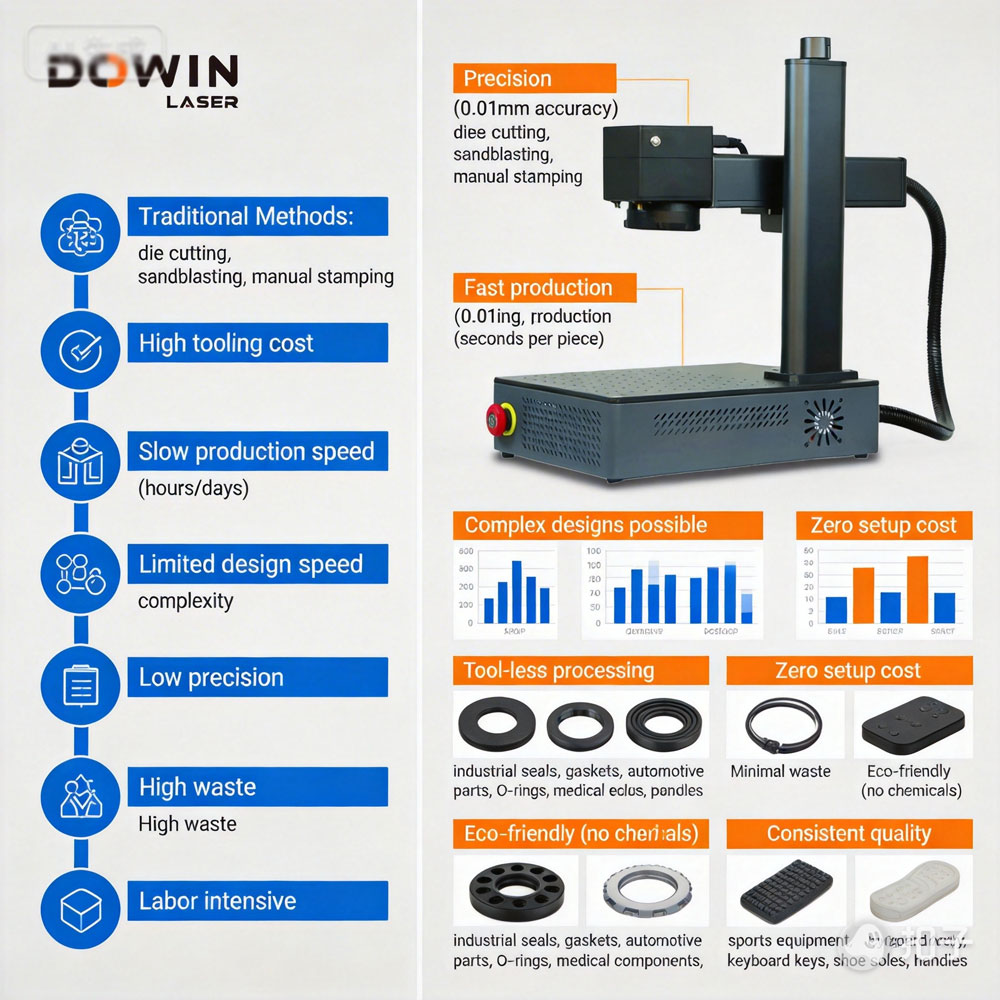
Contents
- 1 1. Why Rubber Is a Manufacturing Challenge
- 2 2. The Breakthrough: Non-Contact Laser Processing
- 3 3. Precision at Scale: What Modern Systems Deliver
- 4 4. From Stamps to Smart Components: Expanding Applications
- 5 5. Material Compatibility: More Complex Than It Looks
- 6 6. Efficiency and Cost: The Hidden Economics
- 7 7. Durability: Built for Harsh Environments
- 8 8. The Environmental Advantage No One Talks About
- 9 9. The Real Limitation: Not Technology, But Understanding
- 10 10. Future Trends: Automation and Intelligent Production
- 11 Final Insight: The Industry Is Underestimating the Shift
- 12 Conclusion
1. Why Rubber Is a Manufacturing Challenge
Rubber is not like metal or plastic. It is:
- elastic and deformable
- heat-sensitive
- chemically complex
Traditional methods—mechanical engraving, stamping, or molding—struggle with:
- deformation under pressure
- tool wear
- limited detail resolution
This is why industries such as automotive, sealing, and industrial manufacturing have long faced a paradox:
they rely heavily on rubber, but cannot process it precisely.
2. The Breakthrough: Non-Contact Laser Processing
Laser engraving solves this problem by eliminating physical contact.
Instead of cutting or pressing, a focused laser beam:
- heats a microscopic area
- alters or vaporizes the surface
- creates permanent, high-contrast marks
This produces:
- clean edges
- detailed graphics
- zero mechanical stress
Key insight:
The real innovation is not the laser itself—it is the removal of force from the process.
3. Precision at Scale: What Modern Systems Deliver
Modern rubber laser systems are designed for industrial performance:
- Marking speeds up to high-throughput production levels
- Engraving depths controlled at micro-level precision
- Continuous operation without tool degradation
Unlike traditional tools:
- no blades dull
- no molds wear out
- no recalibration is needed
Result:
Consistency becomes programmable, not manual.
4. From Stamps to Smart Components: Expanding Applications
Rubber laser engraving is no longer limited to simple stamp production.
It now supports:
Industrial Components
- gaskets and seals
- hoses and belts
- vibration dampers
Identification & Traceability
- serial numbers
- barcodes and QR codes
- compliance markings
Creative & Commercial Uses
- custom rubber stamps
- branding elements
- packaging and design
Across sectors, the goal is the same:
make rubber components readable, traceable, and customizable.
5. Material Compatibility: More Complex Than It Looks
Not all rubber behaves the same under a laser.
Compatible types include:
- natural rubber
- silicone rubber
- EPDM and NBR elastomers
However:
- PVC-based rubber can release harmful gases
- low-quality rubber leads to inconsistent engraving
Hard truth:
Material quality matters more than machine power.
6. Efficiency and Cost: The Hidden Economics
Laser engraving introduces a new cost structure:
Eliminated Costs
- no inks or chemicals
- no tooling or molds
- no consumable wear
Reduced Costs
- less material waste (tight nesting, precision cutting)
- fewer production errors
- lower maintenance requirements
This shifts production from:
tool-dependent → data-driven
7. Durability: Built for Harsh Environments
Rubber components often operate in extreme conditions:
- friction
- stretching
- chemical exposure
- temperature changes
Laser-engraved marks:
- do not fade
- resist abrasion
- remain readable over time
Conclusion:
If marking disappears, traceability disappears.
Laser engraving ensures it never does.
8. The Environmental Advantage No One Talks About
Traditional rubber marking methods rely on:
- inks
- solvents
- chemical treatments
Laser engraving eliminates all of them.
Benefits include:
- cleaner production
- reduced emissions
- no chemical waste
However, there is a critical nuance:
Laser processing still produces fumes—proper ventilation is essential.
Sustainability is not automatic.
It must be engineered into the system.
9. The Real Limitation: Not Technology, But Understanding
Most users approach rubber laser engraving like this:
“What machine should I buy?”
That is the wrong question.
The real challenges are:
- parameter control (power, speed, frequency)
- material selection
- airflow and fume management
- workflow integration
New perspective:
Laser engraving is not a machine—it is a process ecosystem.
10. Future Trends: Automation and Intelligent Production
The next phase of rubber laser engraving is already emerging:
- AI-assisted parameter optimization
- automated feeding and marking systems
- integration with digital manufacturing lines
This will enable:
- real-time quality control
- zero-defect production
- full traceability from raw material to final product
Final Insight: The Industry Is Underestimating the Shift
Most manufacturers still see laser engraving as:
a replacement for traditional tools
That view is outdated.
Laser engraving is not replacing tools—it is replacing uncertainty.
It turns:
- manual variability → digital precision
- physical wear → stable performance
- isolated processes → connected systems
Conclusion
Rubber laser engraving is redefining how industries process one of their most essential materials.
It delivers:
- precision without contact
- durability under extreme conditions
- scalable, efficient production
- integration with digital manufacturing
But the real transformation is deeper:
Rubber is no longer just a functional material.
It is becoming an information carrier within intelligent systems.
And laser engraving is the technology making that transition possible.