
Industrial manufacturing is undergoing a silent revolution. Not driven by labor, not even by automation—but by control over energy at the microscopic level.
Laser technology sits at the center of this shift.
What was once a specialized tool for niche applications has now evolved into a core manufacturing infrastructure, powering everything from aerospace components to everyday hardware. The real story is not that lasers are better—it’s that they are redefining what “manufacturing” even means.
Contents
- 1 1. The Foundation: Why Lasers Changed Industrial Logic
- 2 2. The Three Pillars of Industrial Laser Applications
- 3 3. The Material Revolution Behind Laser Adoption
- 4 4. Industry Penetration: From Niche to Universal
- 5 5. Speed, Cost, and the Economics of Precision
- 6 6. The Rise of Automation and Intelligent Manufacturing
- 7 7. Sustainability: Precision as Environmental Strategy
- 8 8. The Real Limitation: Human Thinking
- 9 Final Insight: Manufacturing Is Becoming Energy Programming
- 10 Conclusion
1. The Foundation: Why Lasers Changed Industrial Logic
Traditional manufacturing relies on contact:
- cutting with blades
- welding with arcs
- marking with pressure or ink
Laser processing eliminates contact entirely.
Instead, it uses a concentrated beam of energy to:
- melt
- vaporize
- or modify material surfaces
This creates a fundamentally different paradigm:
- no mechanical stress
- minimal deformation
- extreme precision
Laser processing is especially suitable for:
- high-hardness materials
- brittle substrates
- high-melting-point components
- ultra-precision parts
Key shift:
Manufacturing is no longer about force—it is about controlled energy delivery.
2. The Three Pillars of Industrial Laser Applications
Despite rapid evolution, industrial laser applications still revolve around three core processes:
1. Laser Marking — Turning Products into Data Carriers
Laser marking creates:
- permanent, non-erasable identification
- barcodes, QR codes, serial numbers
- anti-counterfeiting features
Unlike ink or labels, these marks:
- do not fade
- do not detach
- survive extreme environments
New perspective:
Marking is no longer cosmetic—it is the entry point of digital manufacturing systems.
2. Laser Welding — Precision at the Molecular Level
Laser welding works by:
- focusing heat into a localized area
- forming a controlled molten pool
- achieving deep, narrow weld seams
Two modes exist:
- heat conduction welding (shallow, controlled)
- deep penetration welding (fast, high strength)
Applications include:
- automotive structures
- aerospace components
- high-speed rail systems
Insight:
Laser welding is not just joining materials—it is engineering material behavior under extreme precision.
3. Laser Cutting — Complexity Without Constraints
Laser cutting allows:
- micro-holes
- intricate geometries
- 2D and 3D processing
Advantages include:
- narrow kerf width
- smooth edges
- minimal heat-affected zones
- high-speed production
Unlike traditional cutting:
- no tool wear
- no physical contact
- unlimited shape flexibility
Conclusion:
Design is no longer limited by tools—only by imagination.
3. The Material Revolution Behind Laser Adoption
Modern industries rely on increasingly complex materials:
- titanium alloys
- ceramics
- composite materials
- coated metals and engineered plastics
These materials are often:
- too hard
- too brittle
- too sensitive
for conventional methods.
Laser processing adapts seamlessly across:
- metals (steel, aluminum, titanium)
- plastics and resins
- ceramics and coated surfaces
Hard truth:
The rise of advanced materials forced the adoption of lasers—not the other way around.
4. Industry Penetration: From Niche to Universal
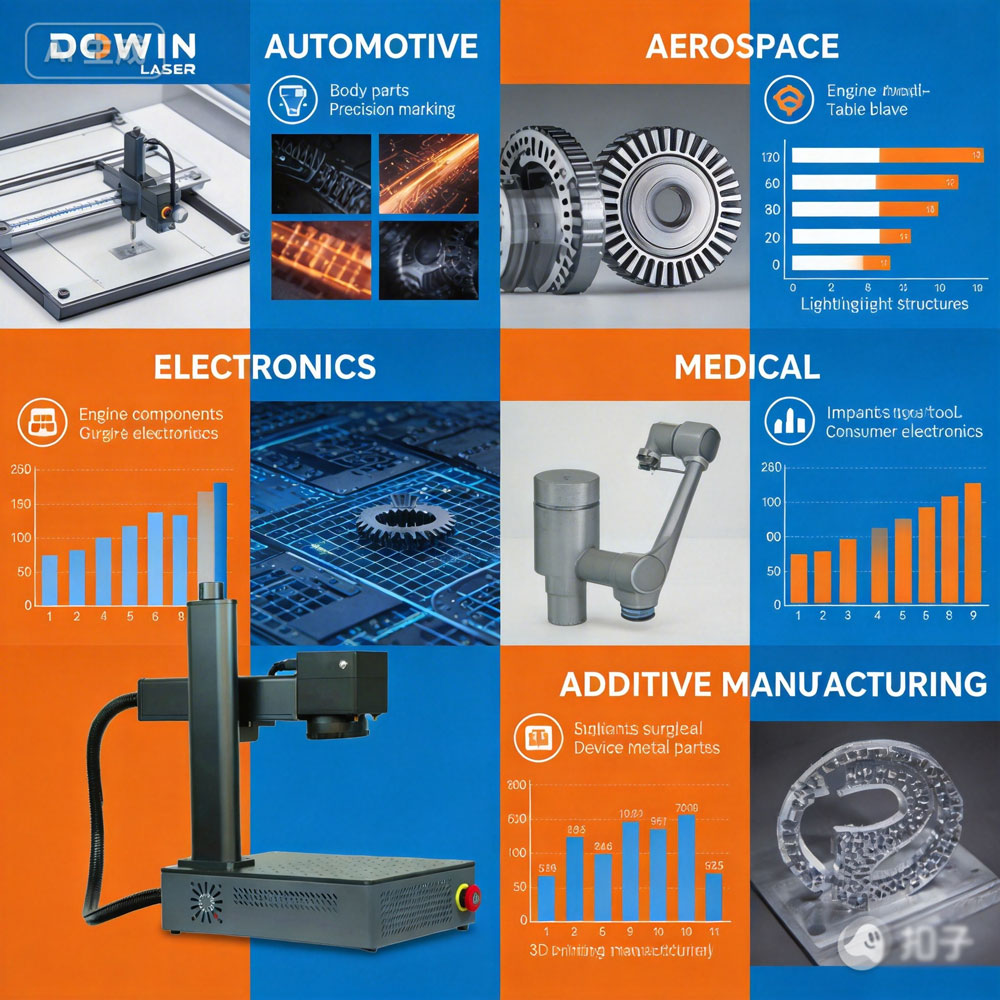
Laser technology is now embedded across industries:
- Electronics and semiconductors
- Automotive and aerospace
- medical and precision instruments
- industrial machinery and tools
- packaging and consumer products
Historically, lasers became widely adopted only after the 1980s, when reliability and power improved enough for industrial use.
Today, they are no longer optional—they are baseline infrastructure.
5. Speed, Cost, and the Economics of Precision
Laser systems deliver:
- high-speed processing
- reduced production cycles
- minimal post-processing
They also eliminate:
- tooling costs
- frequent maintenance
- consumables like inks or cutting tools
This creates a new cost structure:
Higher upfront investment → lower long-term operational cost
Strategic implication:
Laser adoption is less about saving money—and more about stabilizing production quality at scale.
6. The Rise of Automation and Intelligent Manufacturing
Laser systems integrate naturally with:
- robotics
- vision systems
- automated production lines
This enables:
- real-time adjustments
- consistent output
- reduced human error
Modern manufacturing is moving toward:
closed-loop systems where machines monitor and correct themselves
Laser technology is one of the few processes precise enough to support this shift.
7. Sustainability: Precision as Environmental Strategy
Laser processing reduces:
- material waste
- chemical usage
- energy inefficiency
Unlike traditional methods:
- no inks or solvents are required
- no physical tools degrade
However, sustainability depends on system design:
- energy consumption
- fume extraction
- process optimization
Key idea:
Precision is not just a technical advantage—it is an environmental strategy.
8. The Real Limitation: Human Thinking
Most companies still treat lasers as:
“better tools”
That is a fundamental misunderstanding.
Lasers do not just improve processes—they change process logic:
- from mechanical → digital
- from reactive → controlled
- from variable → predictable
Final Insight: Manufacturing Is Becoming Energy Programming
The deeper transformation is this:
Factories are no longer shaping materials.
They are programming energy into matter.
Laser technology is the first widely adopted tool that makes this possible.
Conclusion
Industrial laser applications deliver:
- non-contact precision processing
- permanent marking and traceability
- high-strength, high-speed welding
- flexible, complex cutting capabilities
- compatibility with advanced materials
- integration with automation systems
But the real impact goes beyond performance:
Laser technology is redefining manufacturing from a physical process into a controllable, data-driven system.
Those who understand this shift will not just improve production—
they will redesign it entirely.