
Contents
- 1 1. The Hidden Backbone of Modern Manufacturing
- 2 2. From Marking to Meaning: Technologies That Define Permanence
- 3 3. The Real Divide: Contact vs. Non-Contact Manufacturing
- 4 4. Serial Numbers as Data Infrastructure
- 5 5. The Illusion of “Marking” vs. the Reality of “Traceability Engineering”
- 6 6. Choosing the Right System: It’s Not About the Machine
- 7 7. Breaking the Old Paradigm
- 8 8. Final Insight
1. The Hidden Backbone of Modern Manufacturing
Serial numbers are no longer just identifiers—they are the DNA of industrial products. At their core, they are unique alphanumeric codes used to track, verify, and manage products across their entire lifecycle.
But here’s the shift most manufacturers still underestimate:
serial numbers have evolved from passive labels into active data carriers.
In a world driven by Industry 4.0, every marked component becomes a node in a vast data network. From automotive supply chains to medical device compliance, traceability is not optional—it is regulatory, operational, and strategic.
Global manufacturing data suggests that over 70% of quality recalls are linked to traceability failures, not production defects. The implication is clear:
marking is no longer the last step—it is the first step in digital control.
2. From Marking to Meaning: Technologies That Define Permanence
The Telesis framework outlines three dominant marking technologies, each reflecting a different philosophy of permanence:
Laser Engraving — Depth Equals Authority
Laser engraving removes material to create deep, durable marks that survive extreme environments.
This is not just marking—it is material transformation, ideal for aerospace, heavy industry, and defense.
Laser Etching — Speed Meets Precision
Etching modifies the surface through heat, producing raised, high-contrast marks faster than engraving.
It represents a balance between durability and throughput—critical in high-volume production.
Dot Peen (Stamping) — Mechanical Reliability
Dot peen marking uses a pin to indent the surface, creating characters through physical impact.
It thrives where ruggedness matters more than aesthetics, especially in metal-heavy industries.
3. The Real Divide: Contact vs. Non-Contact Manufacturing
A deeper insight often ignored:
- Dot peen = contact-based marking
- Laser = non-contact marking
This distinction is not technical—it is philosophical.
Laser marking, as a non-contact process, preserves structural integrity while delivering high precision and speed.
That makes it indispensable for:
- Medical devices (no contamination risk)
- Electronics (no micro-damage)
- High-speed automated lines
Meanwhile, contact methods still dominate in environments where simplicity and cost outweigh finesse.
4. Serial Numbers as Data Infrastructure
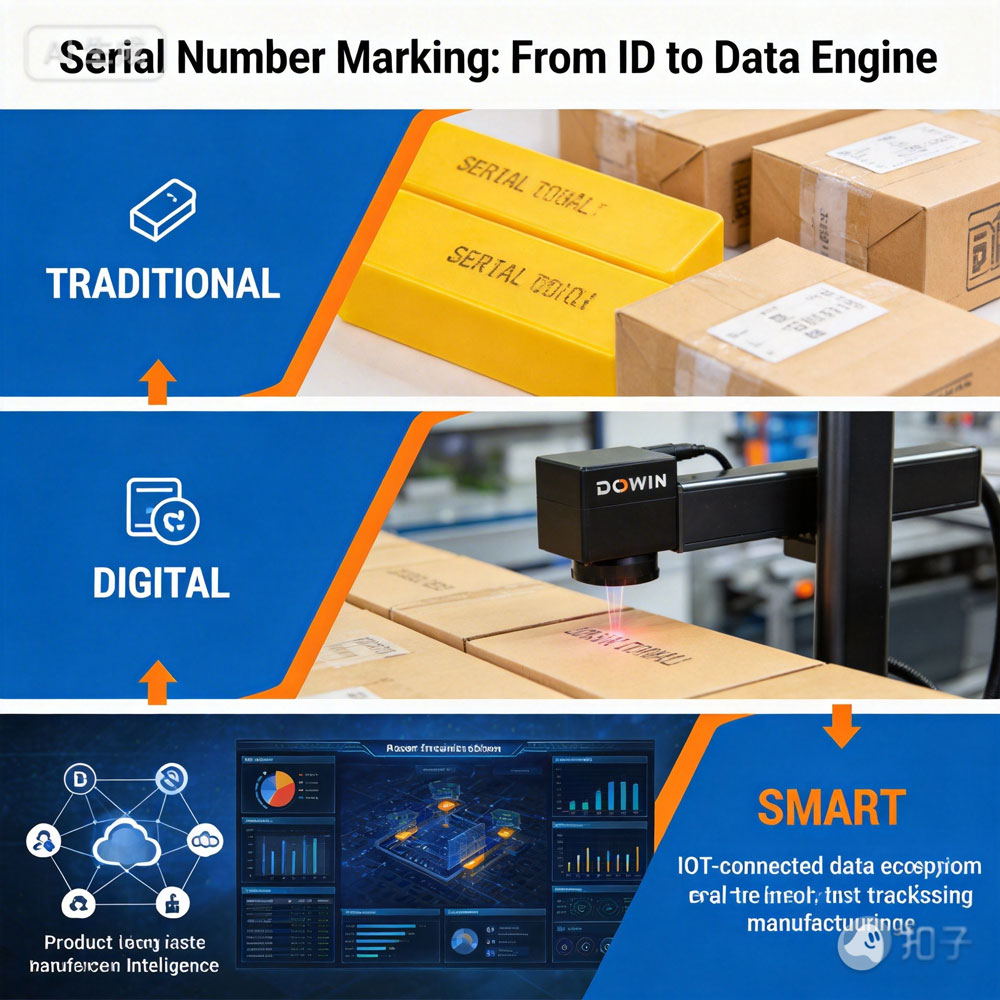
Traditional thinking:
“We mark products so we can identify them.”
Modern reality:
“We mark products so machines can understand them.”
Laser coding systems now generate not only serial numbers, but also:
- QR codes
- Data Matrix (UID, GS1, UDI)
- Embedded production data
These markings integrate directly into MES, ERP, and AI-driven quality systems.
This transforms a simple serial number into:
- A traceability anchor
- A compliance certificate
- A data gateway for predictive analytics
5. The Illusion of “Marking” vs. the Reality of “Traceability Engineering”
Most factories still treat marking as a peripheral process. This is a strategic mistake.
According to industrial practice:
- Labels fail
- Ink fades
- Manual stamping introduces errors
Permanent marking, by contrast, is designed to be tamper-resistant and non-removable, often required by regulation.
The real question is not how to mark, but:
How to ensure that every mark becomes usable intelligence.
6. Choosing the Right System: It’s Not About the Machine
Telesis emphasizes several decision factors:
- Material compatibility
- Marking depth
- Clarity and readability
- Software capability
- Portability and integration
However, the deeper decision is this:
Are you buying a marking machine—or building a traceability system?
Because in advanced manufacturing, hardware is secondary.
Software, integration, and data flow define true value.
7. Breaking the Old Paradigm
Here is the uncomfortable truth:
Most companies are still solving a 20th-century problem (identification)
with 21st-century tools (laser systems)
but missing the 22nd-century opportunity (data ecosystems).
Serial number marking should evolve into:
- Real-time production monitoring
- Digital twins of physical products
- Lifecycle tracking from factory to recycling
The companies that understand this shift will not just improve efficiency—they will redefine manufacturing intelligence.
8. Final Insight
Serial numbers are no longer marks on products.
They are interfaces between the physical world and digital systems.
The future of industrial marking is not about sharper lasers or faster cycle times.
It is about turning every marked surface into a data-bearing asset.
And once that happens, the question is no longer:
“Can you read the serial number?”
But:
“What can you learn from it?”