
Contents
- 1 1. Wood Packaging Is Changing—Faster Than Most Realize
- 2 2. The Core Problem: Traditional Coding Cannot Keep Up
- 3 3. What Is Flying Laser Marking?
- 4 4. Why CO₂ Laser Dominates Wood Applications
- 5 5. From Logos to Data: What Gets Marked Today
- 6 6. The Real Advantage: Integration with Production Lines
- 7 7. Environmental Pressure Is Accelerating Adoption
- 8 8. Breaking the Industry’s Old Mindset
- 9 9. Final Insight
1. Wood Packaging Is Changing—Faster Than Most Realize
Wood packaging—pallets, crates, export boxes—is no longer just a logistics tool. It has become part of a regulated, traceable, and data-driven supply chain.
Driven by global trade and compliance standards (such as export traceability and anti-counterfeiting), the demand for marking on wood packaging has surged:
- Global logistics volume continues to grow steadily with cross-border trade
- Regulatory requirements demand clear, permanent identification on packaging
- Manual labeling and ink printing are increasingly unreliable
The result:
marking is no longer optional—it is infrastructure.
2. The Core Problem: Traditional Coding Cannot Keep Up
Conventional methods—inkjet printing, labeling, stamping—are facing structural failure:
- Ink fades or smears on rough wood surfaces
- Labels peel under humidity and transport stress
- Manual stamping lacks consistency
More critically, these methods cannot match modern production line speeds.
This is where flying laser marking fundamentally changes the equation.
3. What Is Flying Laser Marking?
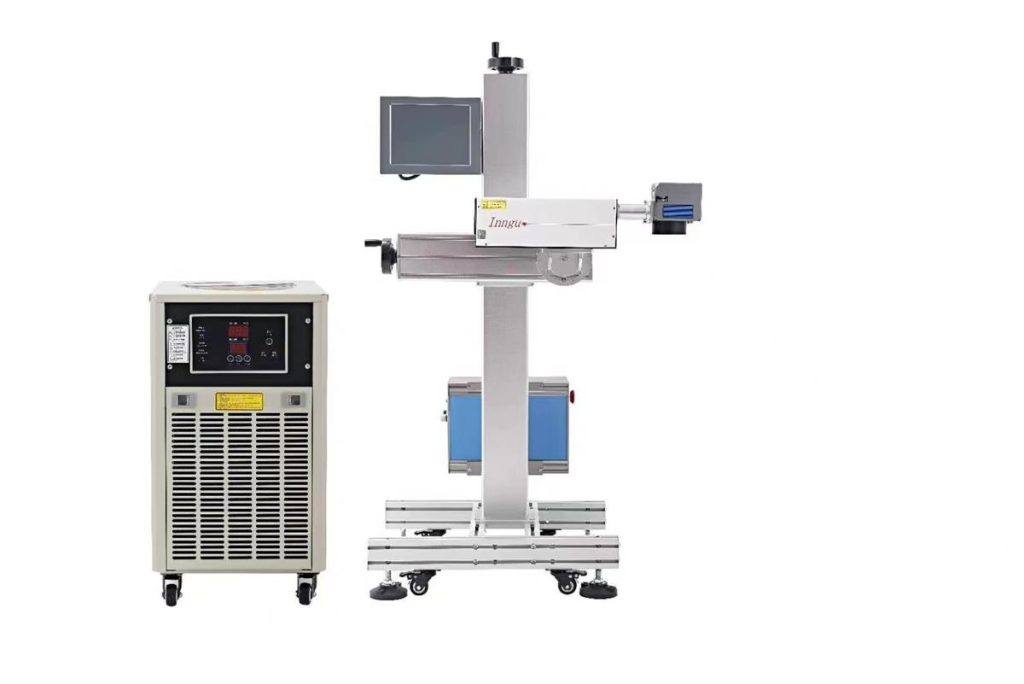
Flying laser marking is an inline, high-speed marking technology where products move continuously while being marked in real time.
Unlike static marking systems:
- No need to stop the production line
- Continuous conveyor-based processing
- Real-time data synchronization
Industrial systems can mark hundreds of units per minute depending on application scenarios
This transforms marking from a bottleneck into a throughput accelerator.
4. Why CO₂ Laser Dominates Wood Applications
For wood packaging, CO₂ laser technology is the dominant solution due to its compatibility with non-metal materials.
Key advantages include:
Non-Contact Processing
No mechanical stress on wood surfaces, preserving structural integrity
High-Speed Inline Capability
Suitable for marking cartons, wooden boxes, and pallets directly on production lines
Permanent and Clear Marking
Laser interacts with the material surface to produce high-contrast marks that do not fade easily
Zero Consumables
No ink, no solvents, no maintenance cycles associated with traditional printers
This is not just efficiency—it is operational simplification.
5. From Logos to Data: What Gets Marked Today
Modern wood packaging marking goes far beyond simple branding.
Flying laser systems can mark:
- Serial numbers
- Barcodes and QR codes
- Export compliance marks
- Batch and production data
- Logos and customized graphics
Each wooden package becomes a data carrier, enabling:
- Real-time tracking
- Warehouse automation
- Supply chain transparency
This is the quiet transformation:
wood packaging is becoming part of the digital ecosystem.
6. The Real Advantage: Integration with Production Lines
The true power of flying laser marking lies in its integration capability.
Modern systems support:
- Conveyor synchronization
- Automated detection and positioning
- Real-time data input (MES / ERP systems)
- Continuous, unattended operation
Instead of marking being a separate process, it becomes embedded into production flow.
This reduces:
- Labor dependency
- Human error
- Downtime
And increases:
- Throughput
- Consistency
- Data accuracy
7. Environmental Pressure Is Accelerating Adoption
There is another force reshaping the industry: sustainability.
Traditional marking methods rely on:
- Chemical inks
- Consumables
- Waste generation
Laser marking eliminates these entirely:
- No consumables
- Minimal waste
- Lower long-term environmental impact
As ESG and environmental regulations tighten globally, this is no longer a “nice to have”—
it is becoming a compliance requirement.
8. Breaking the Industry’s Old Mindset
Most companies still think:
“We need marking for identification.”
That mindset is outdated.
The new reality is:
Marking is part of data infrastructure.
Flying laser marking is not just about speed or clarity—it is about:
- Connecting physical goods to digital systems
- Enabling traceability at scale
- Turning packaging into an information node
9. Final Insight
Wood packaging has historically been low-tech.
Flying laser marking changes that completely.
It transforms:
- Rough surfaces → precision data carriers
- Static packaging → dynamic information systems
- Marking processes → integrated production intelligence
The future of packaging is not about stronger wood or better design.
It is about this:
Every package will carry data—and laser is how that data gets written.