
Contents
- 1 1. The Overlooked Precision Tool
- 2 2. The Core Challenge: Accuracy vs. Durability
- 3 3. Why Laser Technology Redefines Metal Ruler Marking
- 4 4. The Hidden Variables That Decide Accuracy
- 5 5. Durability: Where Most Marks Fail
- 6 6. Surface Preparation: The Step Most Ignore
- 7 7. Speed vs. Quality: The Industrial Trade-Off
- 8 8. Breaking the Conventional Thinking
- 9 9. Final Insight
1. The Overlooked Precision Tool
A metal ruler seems simple—but in manufacturing terms, it is a high-precision measuring instrument. Every millimeter mark must be:
- Geometrically accurate
- Visually sharp
- Resistant to wear over years of use
Even a deviation of ±0.05 mm can compromise usability in industrial or engineering contexts. This makes ruler marking not just cosmetic—but metrological.
2. The Core Challenge: Accuracy vs. Durability
Most manufacturers fail because they treat these as separate goals:
- Accuracy → fine lines, micro-scale precision
- Durability → deep engraving, resistance to abrasion
In reality, these two are tightly coupled.
Shallow marks may look sharp but wear out quickly. Deep engraving improves durability but risks distortion or burr formation if not controlled.
The real objective is balance:
high-fidelity marking that survives mechanical friction.
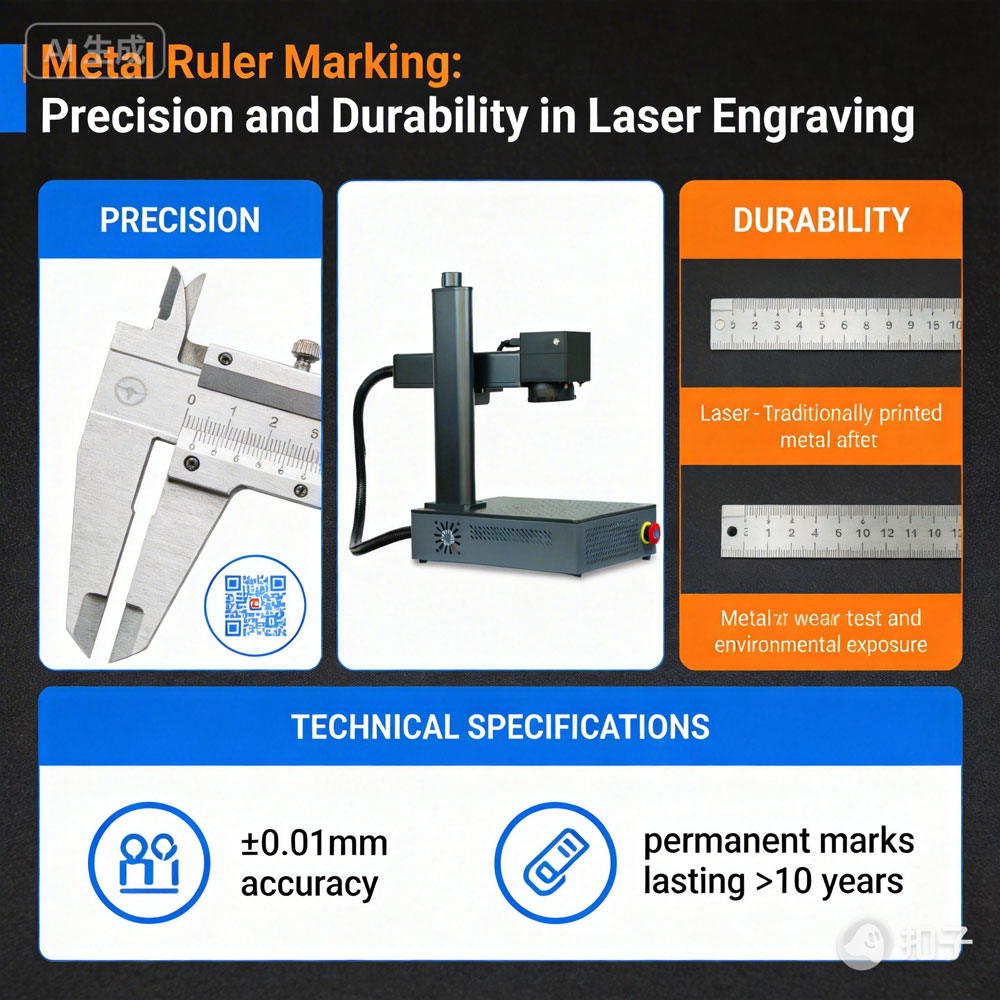
3. Why Laser Technology Redefines Metal Ruler Marking
Laser marking introduces three critical advantages:
Non-Contact Precision
No tool wear, no deformation, no mechanical stress on the metal surface.
Micron-Level Accuracy
Modern systems can achieve ±5–10 μm precision, enabling ultra-fine scale lines.
Permanent Marking
The mark becomes part of the material itself—resistant to corrosion, friction, and cleaning processes.
This is why laser has become the dominant method for high-end measuring tools.
4. The Hidden Variables That Decide Accuracy
Accuracy is not determined by the machine alone. It is the result of multiple interacting factors:
Beam Quality and Focus
A perfectly focused laser produces sharp, narrow lines. Even a 0.1 mm deviation in focus can blur edges and reduce readability.
Motion Control and Galvo System
High-performance galvanometers ensure precise positioning. Poor calibration leads to distortion or scale misalignment.
Material Consistency
Different metals respond differently to laser energy. Grain structure, reflectivity, and coatings directly affect clarity and contrast.
Fixturing Stability
If the ruler shifts during marking—even microscopically—accuracy is lost. Stable fixtures are non-negotiable.
5. Durability: Where Most Marks Fail
A ruler is a high-friction tool. It is dragged across surfaces, exposed to oils, and subjected to repeated handling.
Durability depends on:
- Marking depth
- Surface oxidation or engraving method
- Material hardness
Laser marking offers multiple approaches:
- Annealing: smooth, corrosion-resistant, but less wear-resistant
- Engraving: deeper, more durable, ideal for industrial rulers
Marks created through material transformation cannot peel or fade like ink or coatings.
6. Surface Preparation: The Step Most Ignore
One of the simplest yet most overlooked factors:
Surface condition determines marking quality.
Contaminants such as oil, dust, or oxide layers can:
- Reduce contrast
- Cause uneven marking
- Create inconsistent depth
Clean, uniform surfaces enable maximum energy absorption and clarity.
7. Speed vs. Quality: The Industrial Trade-Off
High-speed production introduces a dilemma:
- Faster marking → lower energy per unit area
- Lower energy → reduced contrast and depth
Manufacturers must optimize:
- Laser power
- Scan speed
- Pulse frequency
The goal is not maximum speed—but maximum consistency at scale.
8. Breaking the Conventional Thinking
The industry still operates under an outdated assumption:
“A ruler is a simple product.”
In reality, a high-quality metal ruler is a precision-engineered interface between human measurement and physical reality.
Laser marking transforms it into:
- A calibrated instrument
- A long-life industrial tool
- A standardized data reference
9. Final Insight
Improving metal ruler marking is not about choosing a better machine.
It is about controlling a system:
- Optics
- Material
- Motion
- Environment
When these align, the result is not just a clear mark—but a trustworthy measurement tool.
And in precision engineering, that trust is everything.