
Home › Forums › Laser Marking Forum › Fiber Laser Marking for Hardware Tools: Precision, Speed, Durability
- This topic is empty.
-
AuthorPosts
-
03/25/2026 at 4:53 AM #877
Dwmin
Keymaster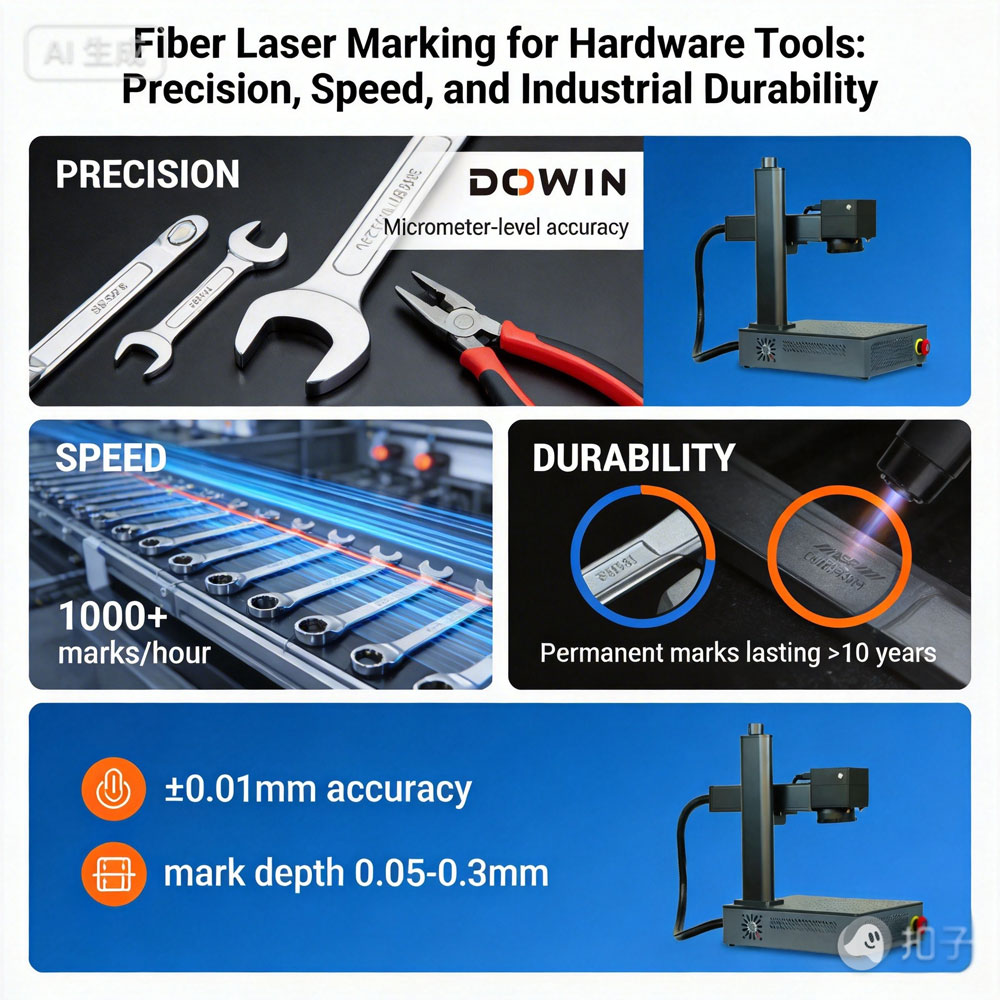
1. Hardware Tools Are Entering a Precision Era
Hardware tools—wrenches, pliers, drill bits, blades—were once defined by strength alone. Today, they are defined by identity, traceability, and precision branding.
Global manufacturing trends show:
- Tool exports are increasingly regulated by traceability standards
- Counterfeiting in hardware markets continues to rise
- End-users demand clear, permanent product information
This shifts marking from a secondary step into a core manufacturing requirement.
2. The Failure of Traditional Marking Methods
Conventional approaches—ink printing, stamping, labeling—are rapidly becoming obsolete in hardware applications:
- Ink fades under oil, friction, and environmental exposure
- Stamping introduces stress and inconsistency
- Labels cannot survive long-term industrial use
These methods were designed for visibility, not longevity.
In contrast, modern hardware tools require marks that last as long as the tool itself.
3. Fiber Laser Marking: Built for Metal, Designed for Industry
Fiber laser technology is fundamentally aligned with metal processing—the backbone of hardware manufacturing.
Its core advantages include:
Extreme Precision
Laser beams can produce ultra-fine lines and complex patterns with high repeatability, enabling detailed logos, serial numbers, and codes even on small tools
Non-Contact Processing
No physical force is applied, eliminating deformation or micro-damage—critical for precision tools
Permanent Marking
The mark becomes part of the material, resistant to wear, corrosion, and harsh environments
Multi-Material Compatibility
Suitable for stainless steel, aluminum, alloys, coated metals, and more—covering nearly all hardware tool materials
This is why fiber laser has become the default standard in modern tool manufacturing.
4. Efficiency at Scale: The Hidden Competitive Edge
Speed is where fiber laser marking becomes transformative.
Modern systems can:
- Operate at high marking speeds for mass production
- Maintain consistency across thousands of units
- Integrate seamlessly into automated production lines
Unlike traditional methods, there is:
- No downtime for consumable replacement
- No tooling wear
- No manual rework
This leads to a critical shift:
Marking is no longer a cost center—it becomes a productivity multiplier.
5. From Branding to Data Encoding
Hardware tools are no longer just branded—they are digitally identified.
Fiber laser systems can mark:
- Serial numbers
- QR codes and barcodes
- Batch and production data
- Anti-counterfeiting identifiers
This enables:
- Supply chain tracking
- Warranty and lifecycle management
- Smart inventory systems
Each tool becomes a data node, not just a physical object.
6. Durability: The True Benchmark
Hardware tools operate in extreme conditions:
- Mechanical friction
- Oil and chemical exposure
- Outdoor environments
Laser marking excels because it alters the material surface itself, creating marks that:
- Do not peel or fade
- Resist abrasion
- Maintain readability over years of use
In industries like automotive or construction, this durability is not optional—it is mandatory.
7. Environmental Pressure Is Reshaping the Industry
Traditional marking methods rely heavily on:
- Inks
- Solvents
- Chemical treatments
Fiber laser marking eliminates all of these:
- No consumables
- No waste emissions
- Lower long-term environmental impact
As sustainability regulations tighten globally, this becomes a decisive advantage.
8. The Strategic Shift Most Companies Miss
Many manufacturers still view laser marking as a tool upgrade.
That perspective is outdated.
The real transformation is this:
Fiber laser marking converts hardware tools into traceable, data-integrated assets.
It connects:
- Physical products
- Digital systems
- Manufacturing intelligence
9. Final Insight
Fiber laser marking is not just improving how tools look.
It is redefining what tools are.From anonymous metal objects, they become:
- Identifiable
- Traceable
- Digitally connected
The future of hardware tools will not be judged only by durability or design.
It will be defined by this:
How much data they carry—and how reliably that data survives.
-
AuthorPosts
- You must be logged in to reply to this topic.