
Home › Forums › Laser Marking Forum › Fiber vs UV vs CO₂ Lasers: The Real Battle Behind Industrial Marking
- This topic is empty.
-
AuthorPosts
-
03/26/2026 at 4:31 AM #883
Dwmin
Keymaster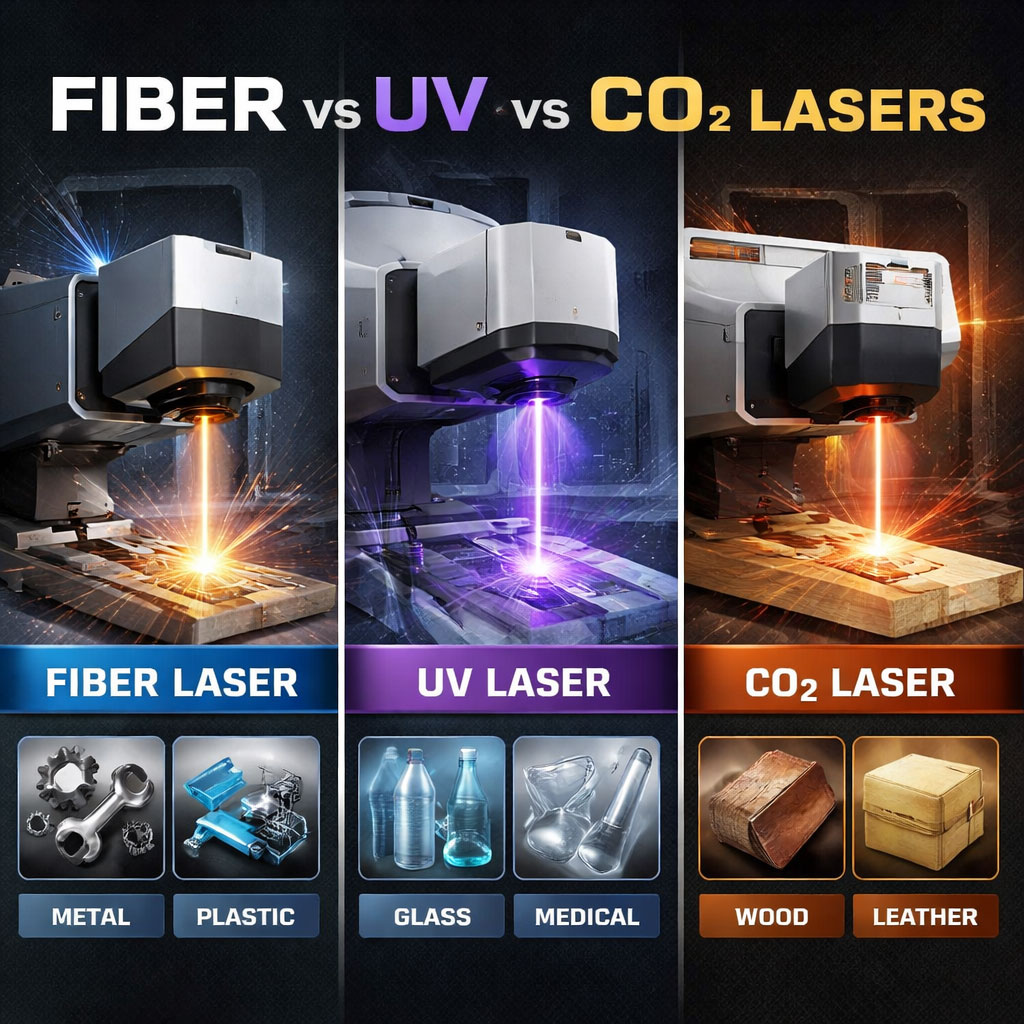
1. The Illusion of Choice in Laser Marking
Most manufacturers believe they are choosing between three technologies:
- Fiber laser
- UV laser
- CO₂ laser
But in reality, they are choosing between three fundamentally different ways of interacting with matter.
The difference is not just performance—it is physics.
At the core lies one variable: wavelength.
And wavelength determines everything—absorption, precision, heat impact, and ultimately, industrial viability.
2. Three Lasers, Three Philosophies
Fiber Laser — Power and Industrial Dominance
Fiber lasers operate around 1064 nm (infrared) and rely on thermal energy to modify materials.
They excel at:
- Metals (steel, aluminum, copper)
- Hard plastics
- High-speed production lines
This is the workhorse of heavy industry—fast, stable, and scalable.
UV Laser — Precision Without Heat
UV lasers operate at 355 nm, using photochemical reactions instead of heat.
This enables:
- Ultra-fine marking
- Minimal thermal damage
- High-contrast results on sensitive materials
Ideal for:
- Electronics
- Medical devices
- Transparent or delicate materials
This is not marking—it is material-level precision engineering.
CO₂ Laser — The King of Organic Materials
CO₂ lasers operate at 10.6 μm, making them highly effective for non-metal materials.
Best suited for:
- Wood, paper, leather
- Acrylic, glass
- Packaging and textiles
They dominate industries where cost efficiency and material compatibility matter most.
3. The Real Comparison (Beyond Marketing)
Factor Fiber Laser UV Laser CO₂ Laser Wavelength 1064 nm 355 nm 10.6 μm Processing Type Thermal Cold (photochemical) Thermal Precision High Very high Medium Heat Impact Medium Very low High Speed Fast Moderate Fast Cost Moderate High Low–Moderate Best Materials Metals Sensitive materials Organic materials (Compiled from industrial data and technical comparisons)
4. The Hidden Rule: Absorption Defines Everything
Here is the principle most people overlook:
If the material does not absorb the wavelength, the laser is useless.
Examples:
- Fiber laser struggles with transparent plastics
- CO₂ laser cannot effectively mark bare metals
- UV laser can mark almost anything—but at higher cost
This is why “which laser is better” is the wrong question.
The correct question is:
Which wavelength matches your material’s absorption spectrum?
5. Speed vs Precision vs Cost: The Industrial Triangle
Every laser system sits inside a three-way trade-off:
- Fiber → Speed + durability
- UV → Precision + minimal damage
- CO₂ → Cost + versatility (non-metals)
No system wins all three.
That’s why high-end factories increasingly deploy hybrid laser ecosystems, not single machines.
6. Industry Reality: One Laser Is Never Enough
Modern manufacturing environments reveal a clear trend:
- Automotive → Fiber for metal parts
- Electronics → UV for micro-marking
- Packaging → CO₂ for high-speed coding
This segmentation is not optional—it is driven by material diversity and production requirements.
Data shows that factories handling multi-material production often invest in multiple laser types to maintain efficiency and quality consistency.
7. Breaking the Biggest Misconception
The industry still asks:
“Which laser is best?”
This is fundamentally flawed.
Because:
Laser marking is not a machine decision—it is a material strategy.
Choosing the wrong laser is not a small inefficiency.
It leads to:- Poor contrast
- Material damage
- Production bottlenecks
- Increased long-term cost
8. The Future: From Machines to Material Intelligence
The next phase of laser marking is not about stronger lasers.
It is about:
- Wavelength optimization
- Smart parameter control
- AI-driven material recognition
- Adaptive marking systems
In the near future, machines will not just mark—they will decide how to mark based on material feedback in real time.
9. Final Insight
Fiber, UV, and CO₂ lasers are not competitors.
They are specialists in different physical domains.- Fiber dominates strength
- UV dominates precision
- CO₂ dominates accessibility
The real winners in industrial marking are not those who choose one.
But those who understand this:
Light is not just a tool—it is a language.
And different materials speak different wavelengths. -
AuthorPosts
- You must be logged in to reply to this topic.