
Home › Forums › Laser Marking Forum › How Small Studios Can Break the Laser Marking Barrier
- This topic is empty.
-
AuthorPosts
-
04/03/2026 at 3:15 AM #905
Dwmin
Keymaster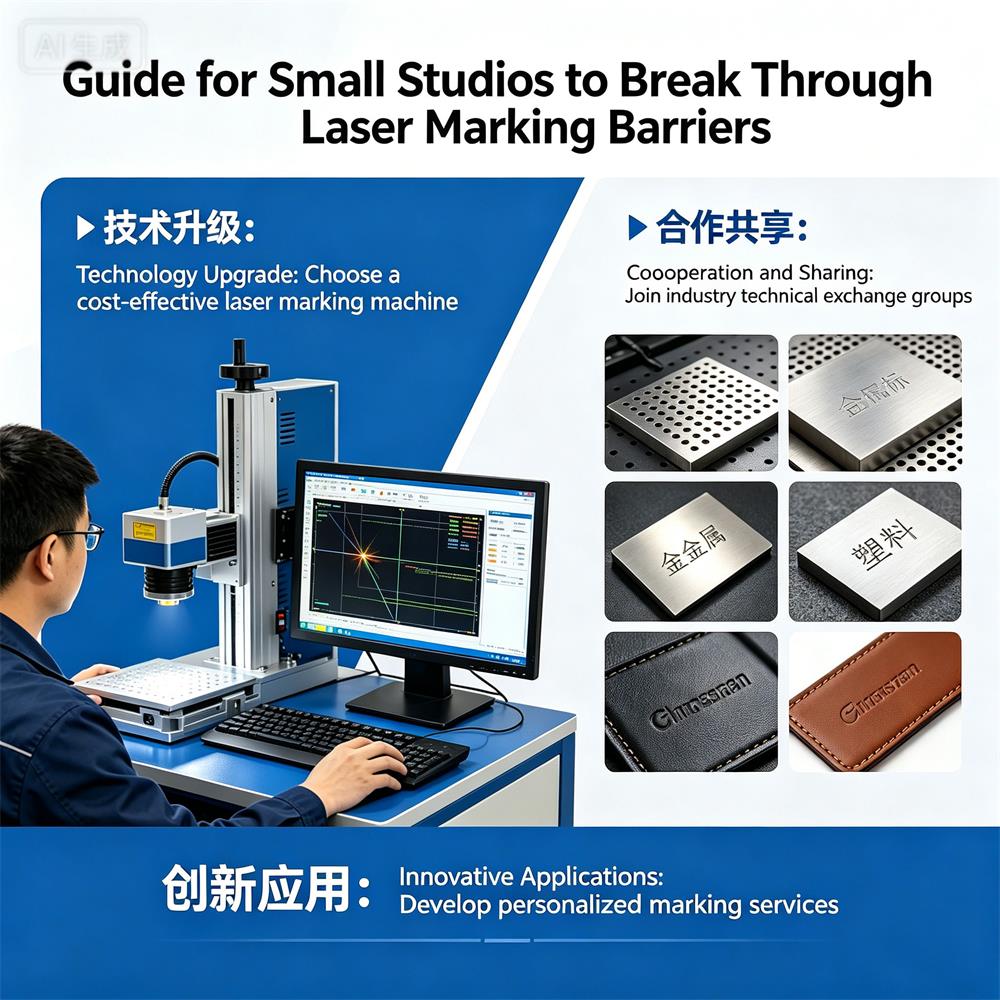
In the past, laser marking belonged to factories with deep pockets and rigid production lines. Today, that barrier has collapsed. Small studios—whether crafting jewelry, customizing products, or building niche brands—are entering a market once dominated by industrial giants. The real question is no longer “Can you afford a laser marking machine?” but “Can you afford to choose the wrong one?”
This guide reconstructs the decision logic behind selecting a laser marking machine for a small studio—removing brand bias, integrating industry trends, and reframing the problem from a growth perspective.
1. Start With Materials, Not Machines
Most buyers make a critical mistake: they start with machine specs instead of material reality.
Laser marking is fundamentally a material–energy interaction problem. Different materials absorb laser wavelengths differently:
- Metals → Fiber lasers dominate due to high absorption efficiency
- Organic materials (wood, leather, acrylic) → CO₂ lasers excel
- Heat-sensitive plastics → UV lasers minimize thermal damage
Choosing the wrong laser type doesn’t just reduce quality—it can destroy your product surface or erase fine details.
Insight:
In small studios, versatility often matters more than raw capability. If your product mix spans categories, hybrid workflows (outsourcing + in-house specialization) may outperform a “do-it-all” machine.
2. Power Is Not a Status Symbol
There is a persistent myth: higher wattage equals better performance.
Reality is more nuanced:
- 20W–30W → Ideal for fine engraving, low cost, energy efficient
- 50W+ → Suitable for deeper marks, harder materials, higher throughput
For most small studios, precision beats brute force. Overpowered machines increase cost, energy consumption, and risk of over-processing delicate materials.
Industry Data Insight:
Market adoption trends show that entry-level fiber lasers (20W–30W) dominate among startups due to faster ROI cycles and lower operational overhead.
3. Speed vs Precision: The Real Trade-Off
Speed sells. Precision builds brands.
High-end systems offer:
- Stable galvanometer scanning for consistent marking
- Visual positioning systems for repeatable accuracy
- Fine parameter control (frequency, pulse width, waveform)
But here’s the overlooked truth:
In small studios, consistency is more valuable than speed.
A slower machine that produces identical results every time will outperform a faster but inconsistent system—especially in personalized or premium products.
4. Space Is Strategy
Small studios operate under physical constraints. Machine footprint directly impacts workflow efficiency.
Typical compact working areas:
- 110 × 110 mm
- 150 × 150 mm
Larger areas sound attractive—but come with trade-offs:
- Reduced beam density
- Lower precision at edges
- Increased cost
Contrarian View:
Instead of scaling machine size, scale process design:- Use fixtures for batch positioning
- Break large jobs into modular passes
This approach preserves precision without sacrificing flexibility.
5. Software Is the Hidden Engine
Hardware gets attention. Software determines output quality.
Key requirements:
- Compatibility with design tools (AI, DXF, PLT)
- Parameter-level control for material tuning
- Intuitive interface to reduce learning curve
Advanced users leverage:
- Pulse shaping
- Frequency modulation
- Layered marking strategies
Insight:
In competitive markets, software mastery—not hardware—becomes the real differentiator.
6. Safety Is Not Optional—It’s Branding
Laser marking generates fumes, particles, and potential hazards.
Essential considerations:
- Fume extraction systems
- Enclosed structures
- Interlock protection mechanisms
Reframing:
Safety is not just compliance—it’s part of your brand perception. A clean, controlled workspace signals professionalism to clients.
7. After-Sales Support = Operational Survival
For small studios, downtime is catastrophic.
Critical support elements:
- Remote troubleshooting
- Training resources
- Spare parts availability
Data Insight:
Across equipment-heavy industries, poor support—not machine failure—is the leading cause of operational disruption.
8. The Bigger Picture: Why Laser Marking Is Exploding
Laser marking demand is rising due to three macro trends:
- Mass customization – Consumers want personalized products
- Traceability requirements – QR codes, serial numbers, compliance
- Non-contact processing – Reduced wear, higher precision
Laser marking offers:
- Permanent marks
- High precision
- No mechanical stress on materials
Bold Take:
Laser marking is no longer just a tool—it’s a business model enabler. Studios that adopt early gain a structural advantage in customization-driven markets.
Final Strategy: Choose for Growth, Not Just Today
The right machine for a small studio is not the most powerful or cheapest—it’s the one that aligns with:
- Your core materials
- Your production scale
- Your brand positioning
- Your future expansion path
Simple Decision Framework:
- Single material focus → Specialized laser
- Multi-material creativity → Flexible setup + workflow design
- Premium brand → Prioritize precision and consistency
- Volume growth → Upgrade power and automation later
Closing Perspective
The real shift is not technological—it’s strategic.
Small studios now compete with industrial players not by scale, but by speed of creativity and customization. A laser marking machine is not just equipment—it is a leverage point.
Choose it like you are choosing a business partner.
-
AuthorPosts
- You must be logged in to reply to this topic.