
Home › Forums › Laser Marking Forum › Laser Engraving Machines for Metal: A Complete Guide
- This topic is empty.
-
AuthorPosts
-
03/16/2026 at 2:20 AM #830
Dwmin
KeymasterMetal has always been one of the most difficult materials to process with precision. Traditional methods such as mechanical engraving, stamping, and chemical etching often require physical tools, molds, or corrosive chemicals. Today, however, laser engraving technology has transformed how manufacturers mark and process metal surfaces.
Across industries—from aerospace and automotive manufacturing to jewelry production and consumer electronics—laser engraving machines are becoming the preferred solution for metal marking and customization. Their ability to produce permanent, high-precision markings without physical contact has made them essential tools in modern digital manufacturing.
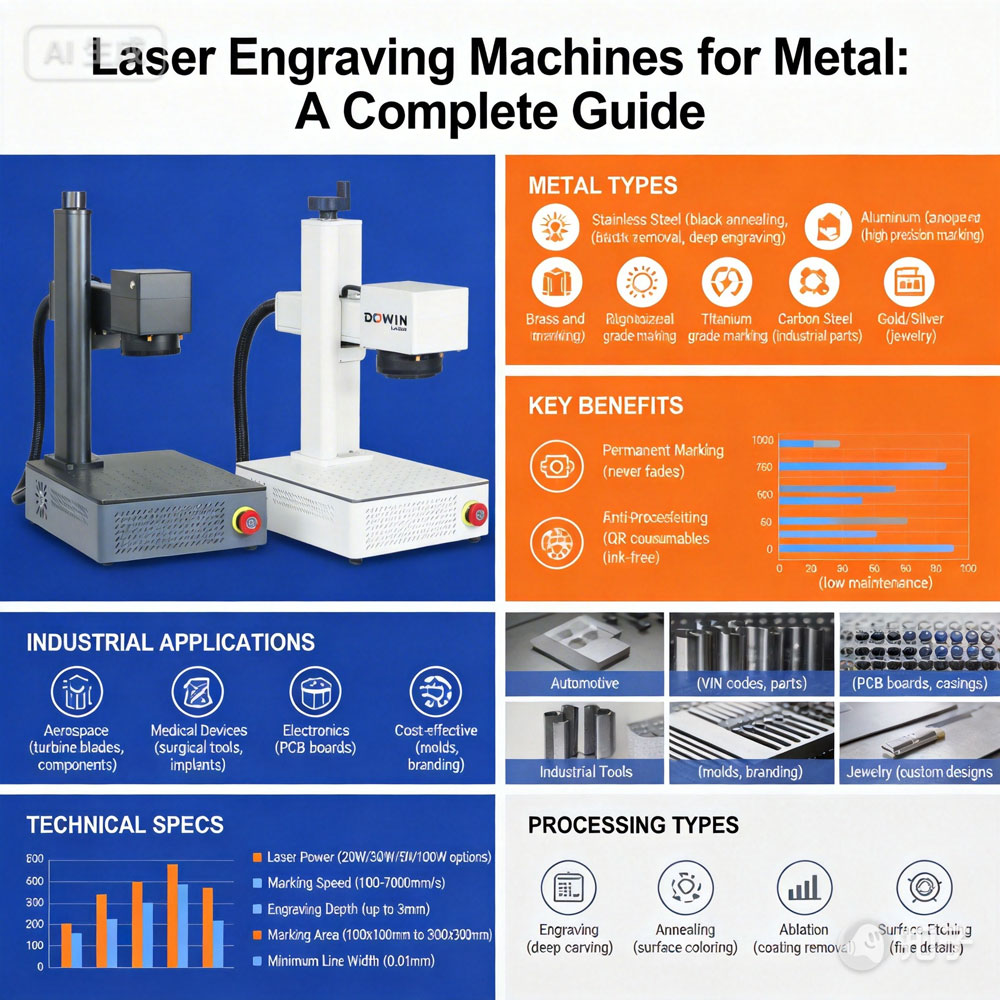
Why Laser Engraving Is Ideal for Metal
Unlike traditional mechanical engraving, laser engraving uses a concentrated beam of light to interact with the metal surface. The laser heats the material to extremely high temperatures within microseconds, causing localized melting or vaporization that forms the engraved pattern.
Because the process is controlled digitally, extremely fine details can be created with micron-level accuracy. The laser beam can mark complex graphics, serial numbers, QR codes, or logos directly onto metal parts without touching the surface.
This non-contact process offers several advantages:
-
no physical tool wear
-
minimal mechanical stress on parts
-
extremely precise engraving
-
permanent markings resistant to wear
These properties make laser engraving especially valuable in industries where durability and traceability are critical.
Types of Lasers Used for Metal Engraving
Different laser technologies are used depending on the type of metal and the desired engraving effect.
Fiber Lasers
Fiber lasers are widely considered the best option for engraving metals such as stainless steel, aluminum, brass, and titanium. They operate at wavelengths around 1064 nm, which metals absorb efficiently, allowing fast and precise engraving.
Fiber lasers are commonly used for:
-
industrial part identification
-
barcodes and serial numbers
-
logos and branding marks
-
deep engraving on tools and machinery
Because of their speed and reliability, fiber lasers have become the standard solution in industrial metal marking.
CO₂ Lasers
CO₂ lasers are more commonly used for non-metal materials such as wood, acrylic, and leather. They can mark certain coated metals, such as anodized aluminum, but generally perform less effectively on bare metal surfaces.
For pure metal engraving, fiber lasers remain the preferred choice.
Infrared and Hybrid Lasers
Some modern engraving systems combine multiple laser sources to increase flexibility. These systems can process both metals and non-metal materials, making them useful for workshops or businesses working with diverse products.
Although hybrid systems provide versatility, they often sacrifice some of the power and efficiency of dedicated fiber lasers.
Metals That Can Be Laser Engraved
Laser engraving machines can process a wide variety of metals used in industrial manufacturing and consumer products.
Common examples include:
-
stainless steel
-
aluminum
-
brass
-
copper
-
titanium
-
gold and silver
Each metal requires slightly different laser settings. For instance, stainless steel can be engraved quickly with moderate laser power, while highly reflective metals such as copper may require higher peak power or adjusted parameters to achieve clear markings.
Applications Across Modern Industry
Laser engraving machines are used in many industries where permanent marking and product identification are essential.
Industrial Manufacturing
Manufacturers engrave serial numbers, data matrix codes, and tracking information directly onto machine parts to ensure traceability throughout the supply chain.
Automotive Components
Engine parts, gears, and mechanical components often require durable identification marks that can withstand heat, friction, and chemical exposure.
Electronics Production
Tiny electronic components require extremely small identification codes. Laser engraving enables precise micro-marking without damaging delicate circuits.
Jewelry and Custom Products
Laser engraving is widely used for personalized jewelry, watches, and luxury accessories because it can create intricate designs on precious metals.
Choosing the Right Laser Power
Laser power determines both engraving depth and production speed.
Typical power levels include:
-
20W lasers – suitable for light marking and small projects
-
30W lasers – faster engraving and deeper marks
-
50W or higher – industrial applications requiring deeper engraving on metal surfaces
For example, simple surface markings such as logos or serial numbers can be produced efficiently with a 20-30W system, while heavy industrial parts may require higher power to create deep, permanent engravings.
Advantages Over Traditional Metal Marking
Laser engraving offers several advantages compared with traditional marking technologies.
Precision and Detail
Laser beams can be focused to extremely small spots, allowing very fine patterns and micro-text.
Permanent Markings
The engraving becomes part of the material itself, making it resistant to wear, corrosion, and environmental exposure.
Non-Contact Processing
Because the laser never touches the metal surface, there is no mechanical stress or tool wear.
Automation Compatibility
Laser engraving machines can easily integrate with automated production lines, robotics, and digital manufacturing systems.
These benefits explain why laser engraving is rapidly replacing traditional methods in many industries.
A New Perspective: Laser Engraving as Digital Manufacturing
Many people still view laser engraving as simply a decorative technique. But in modern manufacturing, its role is far more significant.
Every engraved code, serial number, or QR symbol effectively becomes a digital identity for the product. These markings can link physical objects to databases containing production data, quality inspection records, and supply chain information.
In this sense, laser engraving is not just a machining process—it is a bridge between physical manufacturing and digital information systems.
The engraved metal surface becomes a permanent interface between the real world and the digital world.
Conclusion
Laser engraving machines have revolutionized metal processing by enabling precise, permanent, and efficient marking without mechanical contact. Using focused beams of light, these systems can engrave complex designs, identification codes, and decorative patterns on a wide range of metals.
As industries continue moving toward automation, traceability, and digital manufacturing, laser engraving technology will play an increasingly important role.
In the future, the most valuable machines in manufacturing may not be those that simply cut or shape materials—but those that embed information directly into the fabric of metal itself.
-
-
AuthorPosts
- You must be logged in to reply to this topic.