
Home › Forums › Laser Marking Forum › Laser Marking 2D Codes: The Future of Industrial Traceability
- This topic is empty.
-
AuthorPosts
-
03/12/2026 at 5:24 AM #820
Dwmin
KeymasterIn modern manufacturing, products are no longer just physical objects—they are data carriers. From automotive components to medical instruments, every part moving through the global supply chain must be traceable, identifiable, and verifiable. This demand has accelerated the adoption of 2D codes marked directly onto products using laser technology, a solution that combines permanence, precision, and digital integration.
While traditional labeling methods once dominated product identification, they struggle to meet the modern requirements of durability, data density, and automation. Laser-marked 2D codes, however, are transforming how manufacturers embed information into physical products.
Why 2D Codes Are Replacing Traditional Barcodes
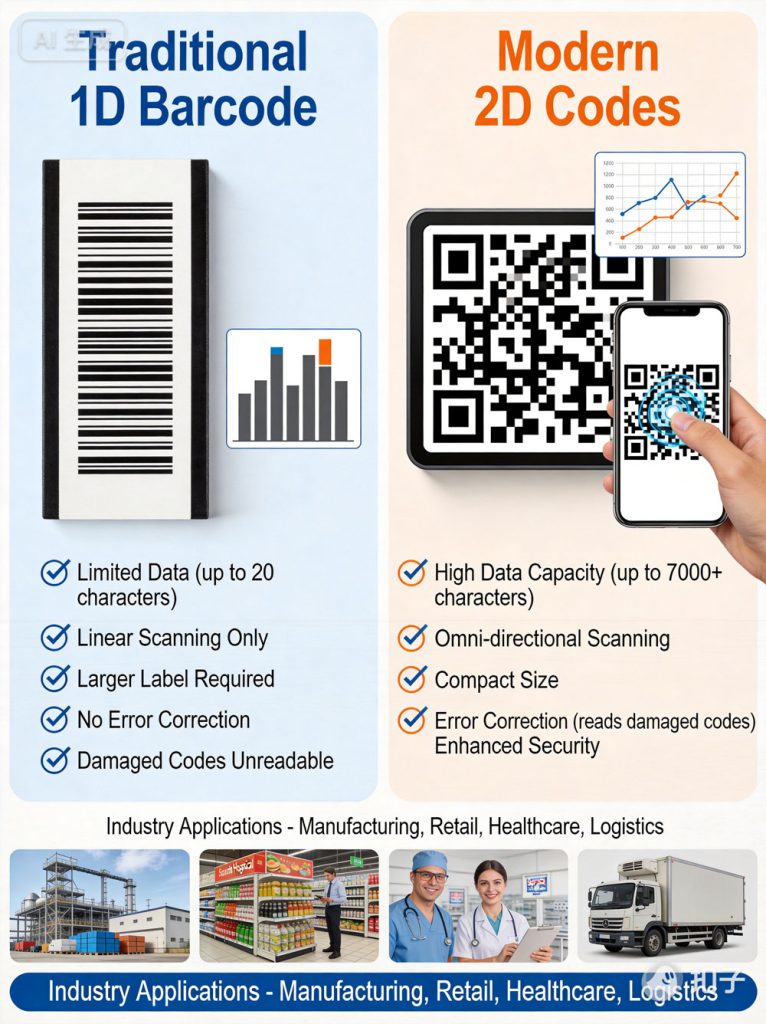
Traditional one-dimensional barcodes store limited data and require relatively large spaces to remain readable. In contrast, modern two-dimensional codes—such as Data Matrix or QR formats—can store hundreds or even thousands of characters within a very small area.
This capability allows manufacturers to encode detailed information directly onto products, including:
-
serial numbers
-
production batch information
-
manufacturing dates
-
traceability records
-
inspection data
The compact nature of 2D codes makes them especially valuable in industries where marking space is extremely limited, such as semiconductor manufacturing, electronics, and medical device production.
In fact, regulatory frameworks increasingly require such traceability systems. Medical devices, for example, must include unique identification codes that enable regulators and manufacturers to track the entire lifecycle of a product—from manufacturing to end-user deployment.
The Role of Laser Marking in Reliable 2D Coding
While 2D codes are powerful, their effectiveness depends entirely on how they are applied. Labels can peel off, ink printing may fade, and mechanical engraving can damage delicate components.
Laser marking addresses these limitations by modifying the material surface directly using concentrated light energy. This process produces permanent codes resistant to abrasion, chemicals, and extreme temperatures, ensuring readability even in harsh industrial environments.
Unlike conventional printing methods, laser systems do not rely on inks or consumables. The beam interacts with the surface material to create contrast through several marking mechanisms, including:
-
Laser etching – melting the surface slightly to produce raised, high-contrast markings.
-
Laser annealing – altering the surface color without removing material, often used for stainless steel and medical devices.
-
Laser foaming – generating light-colored marks on darker plastics by creating microscopic bubbles within the material.
Each technique allows manufacturers to tailor the marking method to specific materials and performance requirements.
Data Density: Small Codes, Massive Information
One of the most remarkable features of 2D codes is their efficiency in storing information. Data Matrix codes, for example, can encode large amounts of data within extremely compact symbols while remaining machine-readable.
Even if part of the code becomes damaged during manufacturing or product usage, built-in error-correction algorithms allow scanners to recover the data. Some systems can tolerate up to 30% damage and still decode the information accurately.
This resilience is essential in industries such as automotive manufacturing, where components may undergo processes like sandblasting, painting, or high-temperature treatment after marking.
Deep laser engraving can ensure that these codes remain visible even after aggressive surface finishing processes.
Precision That Enables Micro-Scale Identification
Laser beams can be focused to extremely small diameters—sometimes smaller than the width of a human hair. This precision enables the creation of micro-sized 2D codes on tiny components, something nearly impossible with conventional marking technologies.
This capability is particularly valuable for:
-
microelectronics and semiconductor packages
-
surgical tools and implants
-
aerospace components
-
miniature sensors and connectors
As product sizes continue shrinking in advanced manufacturing sectors, this level of precision is becoming increasingly important.
Integration with Smart Manufacturing Systems
The true power of laser-marked 2D codes emerges when they are integrated into digital production systems. Modern manufacturing environments rely heavily on automation and data analytics. Every product moving through a factory may be scanned multiple times to verify identity, track production stages, and monitor quality.
Inline verification systems can scan codes immediately after they are marked, ensuring that only readable and compliant products continue through the production line.
When combined with manufacturing execution systems (MES) and enterprise databases, these codes enable real-time traceability across the entire supply chain.
In other words, the code engraved onto a tiny metal component can unlock a full digital record containing:
-
supplier information
-
processing parameters
-
quality inspection results
-
logistics history
The physical product becomes a gateway to digital manufacturing data.
A Shift in Perspective: From Marking to Information Infrastructure
Most companies still treat marking as a small finishing step in production. But that perspective is rapidly changing.
In the era of Industry 4.0, marking technology is evolving into a critical information infrastructure. Laser-marked 2D codes serve as permanent identifiers that link physical objects to digital databases.
This shift has several implications:
-
Traceability becomes automated rather than manual.
-
Quality control becomes data-driven, not guesswork.
-
Counterfeit protection becomes stronger through unique digital identities.
The humble square of pixels engraved on a metal surface is no longer just a code—it is a digital passport for the product.
Conclusion
Laser-marked 2D codes represent a powerful convergence of manufacturing and information technology. By combining permanent marking with high-density data storage, they enable products to carry their own digital identities throughout their lifecycle.
For modern industries facing strict regulatory requirements, complex global supply chains, and growing automation demands, this technology offers clear advantages:
-
permanent, durable identification
-
extremely compact data storage
-
micro-precision marking capability
-
resilience in harsh environments
-
seamless integration with digital manufacturing systems
In the future, manufacturing may be defined not only by how products are built—but by how intelligently they are identified. Laser-marked 2D codes are quickly becoming the backbone of that transformation.
-
-
AuthorPosts
- You must be logged in to reply to this topic.