
Home › Forums › Laser Marking Forum › Laser Marking for Auto Parts: Precision & Traceability
Tagged: Laser Marking for Auto Parts
- This topic is empty.
-
AuthorPosts
-
03/19/2026 at 4:43 AM #847
Dwmin
KeymasterIn the modern automotive industry, a single vehicle can contain over 30,000 individual components, each requiring identification, traceability, and compliance. Traditional marking methods—labels, ink printing, or mechanical engraving—are no longer sufficient.
Laser marking is not just an upgrade.
It is becoming the infrastructure of intelligent manufacturing.This article reconstructs how laser technology is reshaping auto parts production—from basic identification to full lifecycle control.
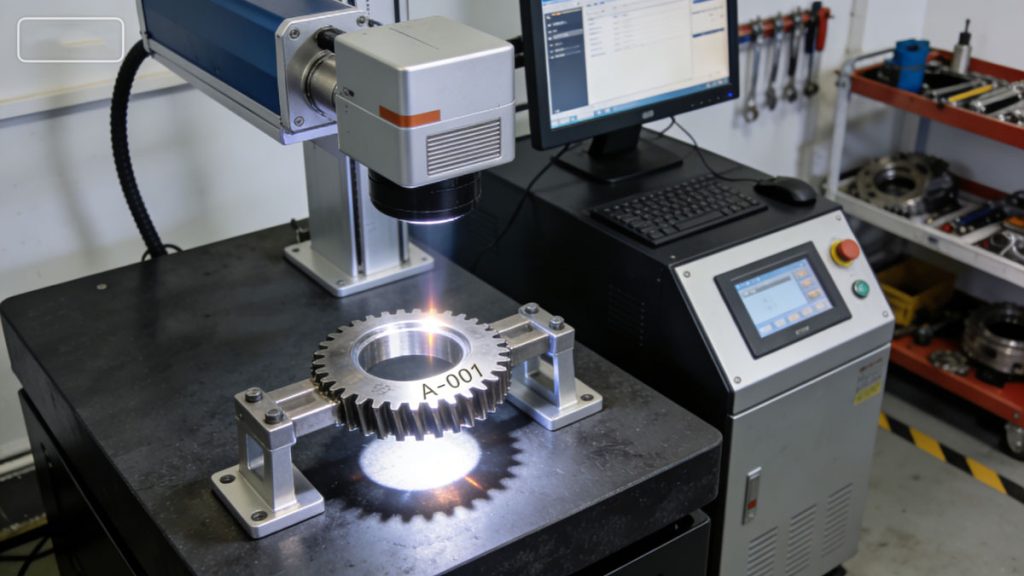
1. Why Automotive Manufacturing Demands More Than “Marking”
Auto parts are not consumer products. They operate in extreme conditions:
-
High temperatures (engine systems)
-
Chemical exposure (oil, coolant, brake fluid)
-
Mechanical stress and vibration
-
Long lifecycle requirements (10+ years)
Under these conditions, traditional markings fail—fade, peel, or become unreadable.
Laser marking solves this by embedding information directly into the material, ensuring permanent, high-contrast identification that survives the entire lifecycle of the component.
2. Core Advantage #1: Traceability Is No Longer Optional
The automotive supply chain is no longer linear—it is global, layered, and highly regulated.
Laser marking enables:
-
Serial numbers and batch tracking
-
QR/DataMatrix codes for digital systems
-
Real-time production traceability
This allows manufacturers to:
-
Track parts from raw material to final assembly
-
Identify defective batches instantly
-
Execute recalls with surgical precision
Without traceability, modern automotive production simply cannot function.
New perspective:
Laser marking is not about labeling parts.
It is about making every part data-readable.
3. Core Advantage #2: Durability Under Extreme Conditions
Auto parts exist in environments that destroy conventional markings.
Laser-marked data remains readable despite:
-
Temperatures from extreme cold to several hundred degrees
-
Exposure to oils, solvents, and chemicals
-
Abrasion, friction, and long-term wear
Unlike ink or stickers:
-
It does not fade
-
It does not peel
-
It does not require reapplication
Conclusion:
If a marking cannot survive the environment, it has zero industrial value.
4. Core Advantage #3: Precision Without Contact
Laser marking is a non-contact process, meaning:
-
No mechanical stress on parts
-
No deformation of precision components
-
No tool wear or consumables
This is critical for:
-
Engine components (tight tolerances)
-
Electronic parts (sensitive surfaces)
-
Thin or coated materials
The result:
high-resolution marking without compromising structural integrity.
5. Core Advantage #4: Full Material Compatibility
Modern vehicles use a wide range of materials:
-
Metals (steel, aluminum, titanium)
-
Plastics and composites
-
Coated and treated surfaces
Laser systems adapt across all of them with parameter control, enabling:
-
Consistent marking standards
-
Unified production workflows
-
Reduced equipment complexity
6. Core Advantage #5: Speed Meets Scale
Automotive production is defined by volume.
Laser marking delivers:
-
High-speed processing for mass production
-
Easy integration into automated lines
-
Continuous operation with minimal downtime
Compared to traditional methods:
-
No drying time
-
No consumable replacement
-
No frequent recalibration
Result:
Higher throughput, lower operational friction.
7. Beyond Marking: Compliance, Anti-Counterfeiting, and Data Systems
Laser marking now plays a critical role in:
Regulatory Compliance
-
Meets global automotive standards
-
Ensures readable, verifiable part data
Anti-Counterfeiting
-
Permanent markings are difficult to replicate
-
Protects supply chain integrity
Digital Integration
-
Enables scanning, tracking, and automation
-
Connects physical parts to digital databases
These capabilities turn marking into a security layer within manufacturing.
8. Sustainability: The Silent Advantage
Laser marking eliminates:
-
Ink
-
Chemicals
-
Labels
This leads to:
-
Lower waste
-
Reduced environmental impact
-
Lower long-term cost
In an industry under pressure to decarbonize, this is not optional—it is strategic.
9. Real Applications Across Auto Parts
Laser marking is already embedded across:
-
Engine components (pistons, crankshafts)
-
Chassis and structural parts
-
Interior plastics and trim
-
Electronic modules and connectors
Each application serves a different purpose—but all share one goal:
making every component identifiable, trackable, and verifiable.
Final Insight: The Industry Is Thinking Too Small
Most companies still see laser marking as a production tool.
That is outdated.
The real shift is this:
Laser marking is becoming the data layer of manufacturing.Every marked part is no longer just a component—it is a data node in a connected system.
Conclusion
Laser marking in the automotive industry is no longer about aesthetics or labeling. It delivers:
-
Permanent identification
-
Full lifecycle traceability
-
High-speed industrial efficiency
-
Compliance and security
-
Sustainable production
The companies that win will not be those with better machines—
but those who understand that marking is now information infrastructure. -
-
AuthorPosts
- You must be logged in to reply to this topic.