
Home › Forums › Laser Marking Forum › Laser Marking in Agriculture: Powering Smart Farming
Tagged: Laser Marking in Agriculture
- This topic is empty.
-
AuthorPosts
-
03/19/2026 at 5:01 AM #850
Dwmin
KeymasterAgriculture is no longer a low-tech industry. It is a data-intensive, regulation-driven, and globally interconnected system. From tractors to irrigation components, every piece of equipment must now be identifiable, traceable, and compliant.
In this context, marking technology—especially laser-based solutions—has quietly become a critical layer of modern agricultural infrastructure.
This is not about labeling parts.
It is about turning physical assets into traceable data points.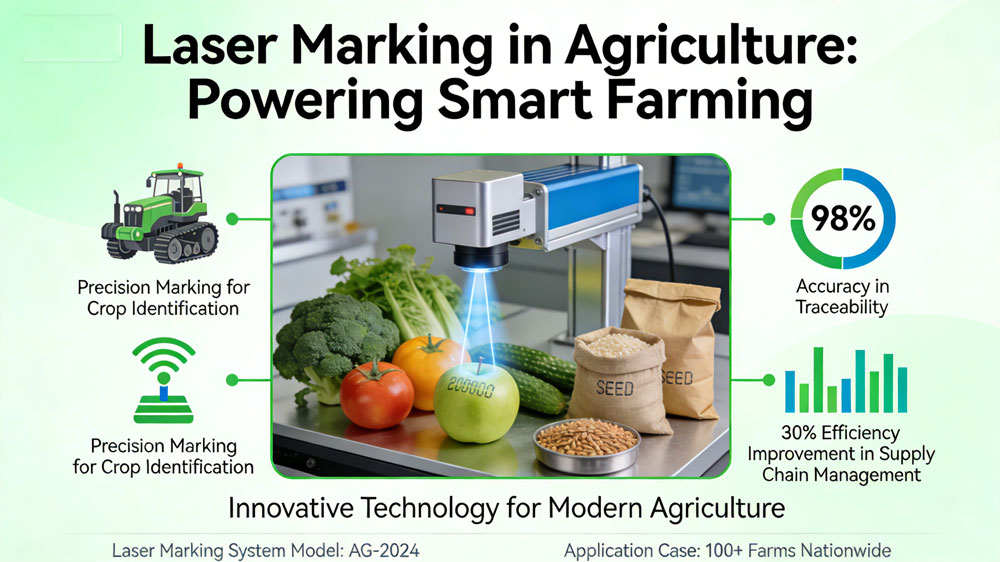
1. The Hidden Complexity of Agricultural Equipment
Agricultural machinery operates in some of the harshest environments of any industry:
-
Constant exposure to mud, dust, and moisture
-
Extreme temperature fluctuations
-
Mechanical shock and vibration
-
Long service lifecycles across multiple seasons
Traditional identification methods—stickers, ink, or paint—fail quickly under these conditions. Once a label disappears, so does traceability.
Permanent marking solves this by embedding information directly into the material, ensuring it remains readable through years of field use and environmental stress.
2. Why Traceability Is Becoming Mandatory in Agriculture
Agriculture is undergoing the same transformation as automotive and aerospace industries:
full lifecycle traceability is becoming a requirement, not an option.Marking enables:
-
Equipment identification (serial numbers, part codes)
-
Component tracking across supply chains
-
Maintenance history recording
-
Anti-counterfeiting measures
This is especially critical as global supply chains expand and agricultural machinery becomes more complex.
New insight:
Without permanent identification, predictive maintenance and smart farming systems cannot function effectively.
3. The Shift Toward Data-Driven Farming
Modern agriculture increasingly relies on precision farming technologies, where decisions are based on real-time data rather than intuition.
Examples include:
-
Monitoring soil conditions and crop variability
-
Tracking machinery usage and performance
-
Optimizing resource input (water, fertilizer, energy)
These systems depend on accurate identification of equipment and components.
Connection rarely discussed:
Laser marking is the physical foundation that links machinery to digital systems.
No identification → no data → no optimization.
4. Technology Advantage: Non-Contact, High-Precision Marking
Laser marking introduces several technical advantages over traditional methods:
Non-contact process
-
No mechanical stress on parts
-
No deformation of sensitive components
High precision
-
Ability to mark small, complex parts
-
Supports QR codes, DataMatrix, and micro-marking
Material flexibility
-
Works across metals, plastics, and coated surfaces
This versatility is essential in agriculture, where machinery combines multiple material types in a single system.
5. Built for Harsh Environments
Agricultural equipment does not operate in controlled factory conditions.
Laser-marked information withstands:
-
Dirt and abrasion
-
Chemicals (fertilizers, fuels, pesticides)
-
Outdoor exposure (UV, rain, temperature swings)
Unlike labels:
-
It cannot peel
-
It cannot fade
-
It cannot be easily removed
This ensures that critical data remains accessible throughout the equipment’s lifecycle.
6. Automation and Smart Manufacturing Integration
With the rise of Industry 4.0, marking is no longer a standalone process.
Modern systems integrate:
-
Automated loading and positioning
-
Vision systems for inspection
-
Robotic control for precision placement
These technologies improve:
-
Production speed
-
Consistency
-
Error reduction
-
Labor efficiency
Key shift:
Marking is becoming part of a fully automated production ecosystem, not a manual step at the end.
7. Sustainability: The Overlooked Advantage
Agriculture is under pressure to become more sustainable—not just in the field, but in manufacturing as well.
Laser marking contributes by:
-
Eliminating inks and chemicals
-
Reducing consumable waste
-
Lowering maintenance requirements
In a sector where efficiency and environmental impact are increasingly linked, this matters.
8. Real Applications in Agricultural Equipment
Laser marking is widely applied across:
-
Tractor and engine components
-
Hydraulic systems and valves
-
Irrigation equipment
-
Tools and attachments
-
Metal frames and structural parts
Each marked component becomes:
-
Identifiable
-
Trackable
-
Verifiable
This enables better maintenance, faster servicing, and more reliable equipment performance.
Final Insight: Agriculture Is Entering the “Industrial Intelligence” Era
Most people still see agriculture as a field-based activity.
That view is outdated.
Modern agriculture is an industrial data system spread across land, machines, and time.
Laser marking plays a subtle but essential role:
-
It connects physical equipment to digital intelligence
-
It ensures data integrity at the source
-
It enables scalable, traceable farming operations
Conclusion
Laser marking in agriculture is no longer just about identification. It delivers:
-
Permanent durability in extreme environments
-
Full lifecycle traceability
-
Compatibility with smart farming systems
-
Integration into automated manufacturing
-
Sustainable, consumable-free operation
The future of agriculture will not be defined only by better crops—
but by better data attached to every piece of equipment.And that starts with how you mark it.
-
-
AuthorPosts
- You must be logged in to reply to this topic.