
Home › Forums › Laser Marking Forum › Laser Marking Transparent Plastics: High-Precision Solutions
- This topic is empty.
-
AuthorPosts
-
03/25/2026 at 5:03 AM #880
Dwmin
Keymaster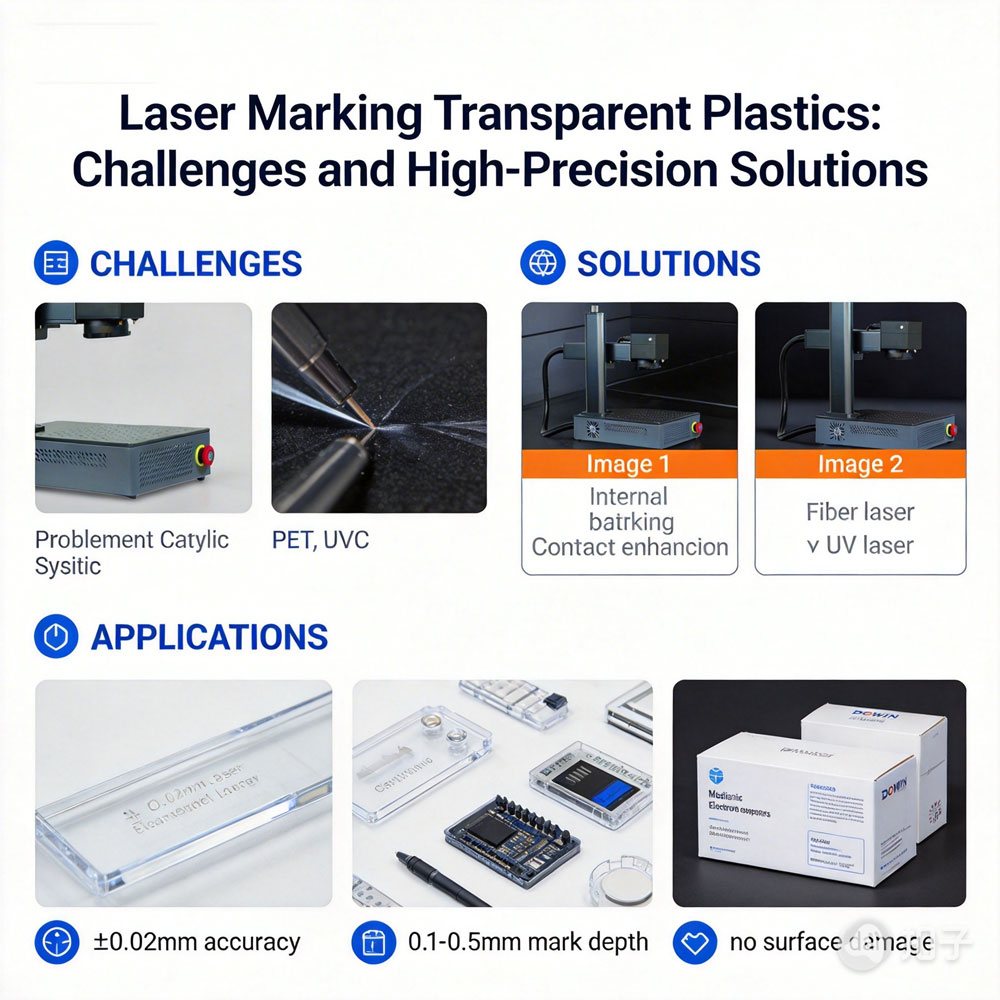
1. Transparency: The Advantage That Becomes a Problem
Transparent plastics such as PC, PMMA, and PET dominate industries like electronics, medical devices, and packaging. Their value lies in optical clarity—but this same property creates a fundamental conflict in laser marking.
Laser marking depends on energy absorption. Transparent plastics, however, are engineered to transmit light rather than absorb it, which leads to:
- Invisible or extremely low-contrast marks
- Inconsistent surface interaction
- Risk of overheating when compensating with higher power
This is not a minor limitation—it is a physics-level contradiction.
2. Why Conventional Lasers Fail on Clear Materials
Most industrial lasers operate in infrared ranges:
- Fiber laser (~1064 nm)
- CO₂ laser (~10.6 μm)
These wavelengths often pass through transparent plastics with minimal interaction. The result:
- No marking effect
- Or uncontrolled thermal damage when power is increased
In simple terms:
You cannot mark what does not absorb energy.
This is why many manufacturers experience “ghost marks” or surface burns instead of clean identification.
3. UV Laser: The Turning Point
The real breakthrough comes from UV laser technology (355 nm).
Unlike thermal-based marking, UV lasers trigger photochemical reactions—a process often called “cold marking.” This enables:
- High-contrast marks on transparent surfaces
- Minimal heat-affected zones
- No melting, yellowing, or structural damage
This is a critical shift:
Traditional lasers rely on heat.
UV lasers rely on molecular interaction.That difference changes everything.
4. Engineering the Material: Additives and Surface Strategies
When base materials resist laser interaction, manufacturers modify the material itself.
Common strategies include:
- Adding laser-sensitive additives (e.g., metal oxides, TiO₂)
- Applying surface coatings or primers
- Using laser-reactive polymer blends
These methods increase energy absorption, enabling visible marking even with less optimal laser types.
However, this introduces a deeper question:
Are you optimizing the process—or redesigning the material?
Leading manufacturers are now doing both.
5. Process Optimization: Where Precision Is Won or Lost
Even with the right laser, results depend heavily on parameter control.
Critical variables include:
- Pulse duration: shorter pulses reduce thermal damage
- Power vs. speed balance: prevents burning or weak marks
- Focus position: must compensate for transparency depth
- Multi-pass strategy: low power passes yield cleaner results
In high-end production, marking is no longer a fixed setting—it is a dynamic process model.
6. Applications: Where This Technology Becomes Essential
Transparent plastic marking is now foundational in multiple sectors:
- Food packaging (date codes on PET bottles)
- Medical devices (sterile, traceable components)
- Consumer electronics (clear housings, display panels)
- Automotive interiors (backlit symbols and controls)
These applications demand three things simultaneously:
- Clarity
- Permanence
- Zero material damage
Traditional methods cannot deliver all three.
7. The Deeper Industry Shift: From Marking to Material Interaction
Here is the misconception most manufacturers still hold:
“Laser marking is a surface process.”
That is outdated.
In transparent plastics, marking becomes:
- A photon-material interaction problem
- A balance between optics, chemistry, and thermal control
This is why success depends less on machine power—and more on wavelength intelligence.
8. Breaking the Old Paradigm
The industry still tries to force traditional tools onto advanced materials.
That approach fails.
The new paradigm is:
- Match laser wavelength to material absorption spectrum
- Engineer materials for laser responsiveness
- Treat marking as part of product design, not post-processing
This is not optimization.
It is co-design between material science and manufacturing technology.
9. Final Insight
Transparent plastics represent a paradox:
- They must remain invisible
- Yet their markings must be visible
Solving this paradox requires more than better machines—it requires rethinking how light interacts with matter.
The future of laser marking is not about higher power.
It is about precision at the wavelength level.And in that future:
The most advanced marks will not be burned into materials—
they will be written at the molecular scale. -
AuthorPosts
- You must be logged in to reply to this topic.