
Home › Forums › Laser Marking Forum › Metal Surface Treatments in Laser Marking Quality
- This topic is empty.
-
AuthorPosts
-
03/30/2026 at 4:24 AM #894
Dwmin
Keymaster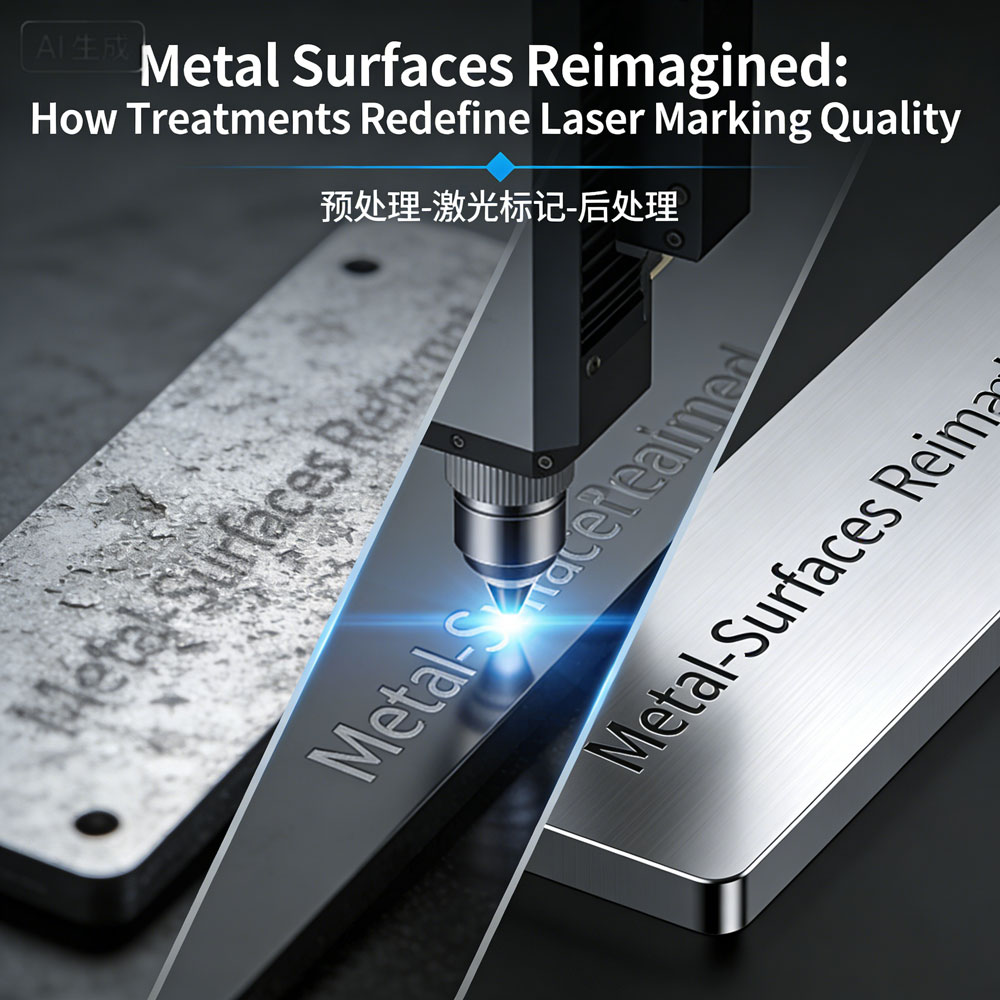
Laser marking on metals is often treated as a parameter problem—adjust the power, tweak the speed, optimize the frequency. That thinking is outdated. The real variable is not the machine. It is the surface.
Across modern manufacturing, surface engineering has become the hidden layer that determines whether a laser mark is sharp, durable, and readable—or inconsistent and commercially useless. Data across industrial applications shows that surface treatment can influence contrast, energy absorption, and defect rates more than laser settings themselves.
This is not a minor factor. It is the control point.
The Core Principle: Laser Meets Material Reality
A laser does not “mark metal” in a generic sense. It interacts with:
- Reflectivity
- Thermal conductivity
- Coating thickness
- Surface uniformity
Even slight variations in these properties can drastically alter results—turning a precise beam into scattered energy or excessive heat.
Conclusion: Surface treatment defines how energy is absorbed, distributed, and transformed into visible marks.
Anodized Aluminum: The Benchmark of Predictability
Among all treated metals, anodized aluminum stands out as the most “laser-friendly” surface.
Why it works:
- Engineered oxide layer absorbs energy efficiently
- Uniform coating ensures consistent interaction
- Laser modifies color without damaging the base metal
Result:
- High-contrast, crisp markings (especially light-on-dark)
- Minimal thermal distortion
- Exceptional repeatability
This is why anodized aluminum dominates applications like electronics housings and data plates. It offers something rare in manufacturing: visual precision with process stability.
Insight: Anodizing is not just corrosion protection—it is a pre-engineered interface for laser energy.
Electroplated Metals: Where Complexity Begins
Electroplated surfaces introduce uncertainty into the system.
The problem:
- Highly reflective coatings reduce energy absorption
- Thickness variations create uneven marking
- Excess energy risks damaging or peeling the coating
Typical outcomes:
- Low contrast
- Patchy or inconsistent marks
- Risk of exposing the base metal
In high-volume industries like automotive trim or decorative hardware, this becomes a critical bottleneck.
Key reality: Laser marking on plated surfaces is not a marking process—it is a balancing act between removal and preservation.
Stainless Steel: Flexible but Thermally Sensitive
Stainless steel offers multiple marking pathways—but each depends heavily on surface condition.
Three primary mechanisms:
- Annealing: oxide-based color change without material removal
- Etching: shallow material removal
- Foaming: raised, textured marks
Surface matters:
- Polished surfaces reflect energy → lower efficiency
- Brushed/matte finishes absorb energy → better uniformity
- Coatings require recalibration to avoid burn or distortion
The same material can produce radically different results depending on finish.
Critical takeaway: Stainless steel is not difficult—it is unforgiving. Precision depends on thermal control and surface absorption.
The Hidden Variable: Surface Condition vs. Surface Treatment
Even within the same treatment, condition overrides classification.
A polished but contaminated surface may perform worse than a rough but clean one.
Key influencing factors:
- Surface roughness → affects beam scattering
- Contamination (oil, dust) → blocks energy absorption
- Microstructure → influences heat diffusion and edge clarity
Manufacturers often overlook this layer, yet it directly determines:
- Edge sharpness
- Contrast consistency
- Defect rates
Clean, uniform surfaces consistently produce superior results—regardless of treatment type.
Breaking Conventional Thinking: Stop Optimizing Lasers First
The industry’s default approach is flawed:
“If the mark is poor, adjust the laser.”
This is backwards.
A more effective hierarchy:
- Engineer the surface
- Match the laser wavelength and pulse regime
- Fine-tune parameters
Surface-first thinking reduces trial-and-error cycles and improves yield stability.
Data-Driven Optimization Strategy
To achieve consistent marking quality across treated metals:
1. Align Surface and Wavelength
- Infrared lasers work well on most metals
- Shorter wavelengths improve performance on reflective or coated surfaces
2. Control Energy Density
- Too low → weak contrast
- Too high → burns, peeling, deformation
3. Standardize Surface Preparation
- Cleaning, sandblasting, or pre-coating can dramatically improve results
4. Embrace Multi-Pass Strategies
Instead of one aggressive pass, multiple controlled passes often yield:
- Better contrast
- Reduced thermal damage
- Higher consistency
Industry Reality: Surface Engineering Is the New Competitive Edge
Manufacturing is shifting toward:
- Higher traceability requirements
- Smaller marking features (QR, UID codes)
- Greater aesthetic expectations
Under these conditions, surface treatment is no longer secondary—it is strategic.
Companies that integrate surface engineering with laser processes achieve:
- Lower defect rates
- Faster setup times
- More consistent global production
Final Perspective: The Mark Is Only as Good as the Surface
Laser technology is often marketed as precise, intelligent, and adaptable. All true. But it is not omnipotent.
It cannot fully compensate for:
- Poor coatings
- Inconsistent finishes
- Contaminated surfaces
The future of laser marking is not about stronger lasers.
It is about smarter surfaces.In advanced manufacturing, the real innovation is no longer in the beam—it is in what the beam touches.
-
AuthorPosts
- You must be logged in to reply to this topic.